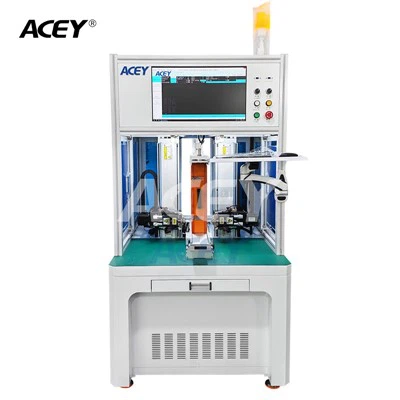
Temperature is a critical factor that significantly impacts the performance of a battery testing system. As a leading supplier of battery testing equipment, we understand the nuances of how temperature variations can affect the accuracy, efficiency, and overall reliability of these systems. In this blog, we will delve into the scientific aspects of temperature's influence on battery testing systems and explore how our cutting - edge products are designed to mitigate these challenges.
The Basics of Battery Testing Systems
Before we discuss the impact of temperature, it's essential to understand the fundamentals of battery testing systems. These systems are used to evaluate the performance, capacity, and safety of batteries. They perform a variety of tests, including charge - discharge cycles, capacity measurement, and internal resistance testing. Our company offers a wide range of battery testing solutions, such as the Lithium Ion Cell Grading Machine, 5V 300A 16 Channels Energy - Feedback Prismatic Battery Cell Grading Machine, and Battery Charge and Discharge Tester. These products are designed to meet the diverse needs of battery manufacturers, research institutions, and other stakeholders in the battery industry.
Temperature and Battery Chemistry
Batteries operate based on chemical reactions. Temperature plays a crucial role in these reactions as it affects the rate of chemical reactions and the mobility of ions within the battery.
Effect on Chemical Reaction Rates
According to the Arrhenius equation, the rate constant (k) of a chemical reaction is related to temperature (T) by the formula (k = A e^{-\frac{E_a}{RT}}), where (A) is the pre - exponential factor, (E_a) is the activation energy, (R) is the gas constant. As the temperature increases, the rate of chemical reactions generally increases. In a battery, this means that the charge and discharge processes can occur more rapidly.
For example, in a lithium - ion battery, at higher temperatures, the lithium ions can move more freely between the anode and the cathode. This can lead to a higher discharge current and potentially a higher capacity being measured during testing. However, if the temperature is too high, it can also cause side reactions, such as the decomposition of the electrolyte or the formation of a solid - electrolyte interphase (SEI) layer on the electrodes, which can degrade the battery's performance over time.
Impact on Ion Mobility
Temperature also affects the mobility of ions in the electrolyte. In a battery testing system, accurate ion mobility is essential for reliable test results. At low temperatures, the viscosity of the electrolyte increases, which reduces the mobility of ions. This can lead to a decrease in the battery's capacity and an increase in its internal resistance.
When testing a battery at low temperatures, the battery may not be able to deliver its full capacity, and the measured internal resistance may be higher than the actual value at normal operating temperatures. This can result in inaccurate test results, leading to misjudgments about the battery's performance and quality.
Temperature and Battery Testing System Components
Apart from affecting the battery chemistry, temperature can also have a significant impact on the components of a battery testing system.
Electronic Components
The electronic components in a battery testing system, such as resistors, capacitors, and integrated circuits, are sensitive to temperature. High temperatures can cause these components to overheat, leading to changes in their electrical properties. For example, the resistance of a resistor may increase with temperature, which can affect the accuracy of current and voltage measurements in the testing system.
In addition, thermal stress can cause mechanical damage to the electronic components over time. This can lead to component failures, which can disrupt the testing process and increase the maintenance costs of the battery testing system.
Sensors
Battery testing systems rely on sensors to measure various parameters, such as current, voltage, and temperature. Temperature variations can affect the accuracy of these sensors. For instance, a temperature - sensitive sensor may produce inaccurate readings if it is exposed to extreme temperatures.
In a battery testing system, inaccurate sensor readings can lead to incorrect test results. For example, if the temperature sensor is not calibrated correctly or is affected by external temperature variations, the system may not be able to accurately compensate for the temperature effects on the battery, resulting in inaccurate capacity and performance measurements.
Temperature Compensation in Battery Testing Systems
To ensure the accuracy and reliability of battery testing, temperature compensation is crucial. Our battery testing systems are equipped with advanced temperature compensation algorithms and technologies.
Temperature Sensors and Monitoring
Our systems are equipped with high - precision temperature sensors that can accurately measure the temperature of the battery and the testing environment. These sensors continuously monitor the temperature and provide real - time data to the system's control unit.
Based on the temperature data, the control unit can adjust the test parameters, such as the charge and discharge currents, to compensate for the temperature effects on the battery. For example, if the temperature is low, the system may increase the charge time to ensure that the battery reaches its full capacity.
Thermal Management
In addition to temperature compensation algorithms, our battery testing systems also feature effective thermal management systems. These systems are designed to maintain a stable temperature environment for the battery during testing.
For example, our testing equipment is equipped with cooling fans and heat sinks to dissipate heat generated during the testing process. In some cases, we also use liquid - cooling systems for more precise temperature control. By maintaining a stable temperature, we can ensure that the battery testing results are accurate and repeatable.
Case Studies
To illustrate the importance of temperature control in battery testing, let's look at some case studies.
Case 1: Testing Lithium - Ion Batteries at Different Temperatures
A battery manufacturer conducted a series of tests on lithium - ion batteries using our Battery Charge and Discharge Tester at different temperatures. At room temperature (around 25°C), the batteries showed a normal capacity and performance. However, when the temperature was lowered to 0°C, the measured capacity decreased by approximately 20%.
When the temperature was increased to 50°C, the initial discharge current was higher, but the battery's cycle life was significantly reduced due to the accelerated side reactions. By using our temperature compensation and thermal management features, the manufacturer was able to obtain more accurate and consistent test results across different temperature conditions.
Case 2: Long - Term Testing of Prismatic Batteries
A research institution used our 5V 300A 16 Channels Energy - Feedback Prismatic Battery Cell Grading Machine for long - term testing of prismatic batteries. During the testing process, they noticed that the test results were inconsistent due to temperature variations in the testing environment.
After implementing our temperature control and compensation solutions, the test results became more stable and reliable. This allowed the research institution to accurately evaluate the long - term performance and degradation of the prismatic batteries.
Conclusion
Temperature has a profound impact on the performance of a battery testing system. It affects both the battery chemistry and the components of the testing system, leading to potential inaccuracies in test results. However, with advanced temperature compensation and thermal management technologies, these challenges can be effectively addressed.


As a leading supplier of battery testing systems, we are committed to providing our customers with high - quality, reliable, and accurate testing solutions. Our products, such as the Lithium Ion Cell Grading Machine, 5V 300A 16 Channels Energy - Feedback Prismatic Battery Cell Grading Machine, and Battery Charge and Discharge Tester, are designed to withstand temperature variations and provide accurate test results.
If you are looking for a reliable battery testing system that can deliver accurate and consistent results, regardless of temperature conditions, we invite you to contact us for more information and to discuss your specific requirements. Our team of experts is ready to assist you in finding the best solution for your battery testing needs.
References
- Arrhenius, S. (1889). Über die Reaktionsgeschwindigkeit bei der Inversion von Rohrzucker durch Säuren. Zeitschrift für physikalische Chemie, 4, 226 - 248.
- Linden, D., & Reddy, T. B. (2002). Handbook of Batteries (3rd ed.). McGraw - Hill.
- Winter, M., & Brodd, R. J. (2004). What are batteries, fuel cells, and supercapacitors?. Chemical Reviews, 104(10), 4245 - 4269.