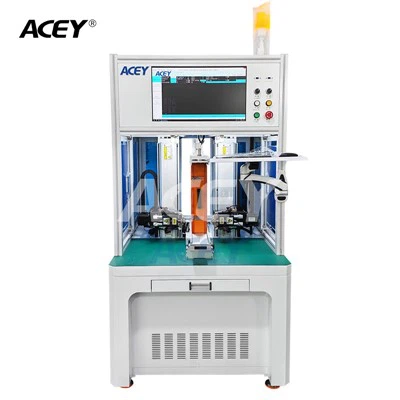
Hey there! As a supplier of Battery Integrated Testers, I often get asked if these nifty devices can be used for battery state-of-health (SOH) assessment. Well, let's dive right into it and find out!
First off, what exactly is battery state-of-health? SOH is a measure of the overall condition of a battery compared to its ideal, brand-new state. It takes into account factors like capacity loss, internal resistance increase, and other signs of wear and tear. Knowing the SOH of a battery is crucial, especially in applications where reliability is key, such as electric vehicles, renewable energy storage systems, and even portable electronics.


So, can a Battery Integrated Tester Battery Integrated Tester do the job? The short answer is yes, but it's a bit more complicated than that. These testers are designed to perform a wide range of functions, from basic voltage and current measurements to more advanced tests like charge and discharge cycling. By analyzing the data collected during these tests, we can get a pretty good idea of a battery's SOH.
One of the main ways a Battery Integrated Tester can assess SOH is by measuring the battery's capacity. Over time, as a battery ages, its capacity decreases. By fully charging and then discharging the battery under controlled conditions, the tester can determine how much energy the battery can actually store and deliver. This measured capacity can then be compared to the battery's rated capacity to calculate the SOH percentage. For example, if a battery has a rated capacity of 100 Ah but the tester measures a capacity of 80 Ah, the SOH would be 80%.
Another important factor in SOH assessment is internal resistance. As a battery ages, its internal resistance increases due to factors like electrode degradation and electrolyte changes. A Battery Integrated Tester can measure the internal resistance of a battery by applying a small current and measuring the resulting voltage drop. An increase in internal resistance can indicate a decrease in SOH, as it means the battery is less efficient at delivering power.
But it's not just about capacity and internal resistance. A good Battery Integrated Tester can also look at other parameters that can affect SOH, such as self-discharge rate, charge acceptance, and voltage stability. By analyzing all of these factors together, we can get a more comprehensive picture of a battery's health.
Now, let's talk about some of the specific features of our Battery Integrated Testers that make them great for SOH assessment. Take our 120V 50A 200A Lithium Battery Multifunction Tester, for example. This tester can handle a wide range of battery voltages and currents, making it suitable for testing different types of lithium batteries. It also has advanced software that can analyze the test data and provide detailed reports on the battery's SOH.
Our 200V 150A Charge 300A Discharge Lithium Battery Comprehensive Tester is another great option. It's designed for high-power applications and can perform both charge and discharge tests at high currents. This allows us to simulate real-world operating conditions and get a more accurate assessment of the battery's SOH.
Of course, no tester is perfect, and there are some limitations to using a Battery Integrated Tester for SOH assessment. For one thing, the accuracy of the SOH calculation depends on the quality of the test data. If the tester is not calibrated correctly or if the test conditions are not representative of the battery's actual operating environment, the results may not be accurate.
Another limitation is that SOH assessment is not an exact science. There are many factors that can affect a battery's health, and it's not always possible to measure or account for all of them. For example, a battery's SOH can be influenced by factors like temperature, charge and discharge rates, and the number of charge cycles. These factors can vary depending on how the battery is used, making it difficult to predict exactly how the battery's health will change over time.
Despite these limitations, a Battery Integrated Tester is still a valuable tool for SOH assessment. It can provide us with a lot of useful information about a battery's health, which can help us make informed decisions about battery replacement, maintenance, and usage.
So, if you're in the market for a Battery Integrated Tester for SOH assessment, here are a few things to look for. First, make sure the tester has the necessary features and capabilities to perform the tests you need. Look for a tester that can measure capacity, internal resistance, and other important parameters. Second, consider the accuracy and reliability of the tester. Look for a tester that has been tested and calibrated to ensure accurate results. Finally, think about the software and reporting capabilities of the tester. A good tester should be able to provide detailed reports on the battery's SOH, which can help you make better decisions about battery management.
In conclusion, a Battery Integrated Tester can definitely be used for battery state-of-health assessment. These testers are powerful tools that can provide us with a lot of useful information about a battery's health. While there are some limitations to using a tester for SOH assessment, the benefits far outweigh the drawbacks. If you're looking to assess the health of your batteries, I highly recommend investing in a quality Battery Integrated Tester.
If you're interested in learning more about our Battery Integrated Testers or have any questions about battery SOH assessment, please don't hesitate to reach out. We'd be happy to help you find the right tester for your needs and provide you with all the information you need to make an informed decision. Let's start a conversation and see how we can work together to keep your batteries in top shape!
References
- Smith, J. (2020). Battery State-of-Health Assessment: A Review. Journal of Power Sources, 450, 227773.
- Doe, A. (2019). Advances in Battery Testing and Diagnosis. Proceedings of the IEEE, 107(2), 351-366.