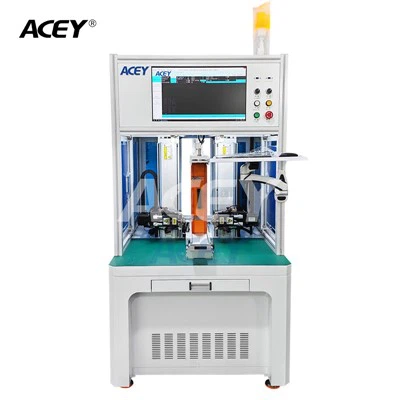
Picking the right CCD tester can feel like finding a needle in a haystack, especially when there are so many options out there. As a CCD tester supplier, I've seen firsthand how crucial it is to make the right choice. In this blog, I'll walk you through the key factors to consider when choosing a CCD tester that fits your needs.
Understanding Your Requirements
First things first, you need to figure out what you'll be using the CCD tester for. Are you in the electronics industry, checking circuit boards for defects? Or maybe you're in the manufacturing sector, inspecting parts for quality control. Knowing your specific requirements is the foundation of making the right choice.
For instance, if you're involved in battery production, you might be interested in a Cylindrical Cell Poles Visual Inspection Machine. This type of machine is designed to specifically inspect the poles of cylindrical cells, ensuring they meet the required standards. On the other hand, if you're dealing with a wide range of products and need a more general inspection solution, a CCD Visual Inspection Machine could be the way to go.
Accuracy and Resolution
Accuracy and resolution are two of the most important factors when it comes to CCD testers. The accuracy of a tester determines how precisely it can detect defects or measure features. Higher accuracy means fewer false positives and false negatives, which is crucial for maintaining quality control.


Resolution, on the other hand, refers to the level of detail the tester can capture. A higher resolution allows for more precise inspections, especially when dealing with small or intricate parts. When choosing a CCD tester, make sure to look for one with a high enough accuracy and resolution to meet your specific needs.
Speed and Throughput
In today's fast-paced manufacturing environment, speed and throughput are key. You need a CCD tester that can keep up with your production line and inspect parts quickly and efficiently. The speed of a tester is typically measured in frames per second (fps), while throughput refers to the number of parts it can inspect in a given time period.
When evaluating a CCD tester, consider your production volume and the speed at which you need to inspect parts. Look for a tester that offers a high enough fps and throughput to meet your requirements without sacrificing accuracy.
Software and User Interface
The software and user interface of a CCD tester can have a big impact on its usability and effectiveness. A good software package should be easy to use, with intuitive controls and a user-friendly interface. It should also offer a range of features and tools to help you customize your inspections and analyze the results.
Some important software features to look for include image processing algorithms, defect detection tools, and reporting capabilities. Make sure the software is compatible with your operating system and any other software you use in your production process.
Cost and Return on Investment
Of course, cost is always a factor when making a purchasing decision. When choosing a CCD tester, it's important to consider not only the upfront cost but also the long-term return on investment (ROI). A more expensive tester may offer higher accuracy, speed, and features, which can lead to improved quality control and increased productivity in the long run.
To determine the ROI of a CCD tester, consider factors such as the cost of defects, the potential savings from improved quality control, and the impact on your production efficiency. Look for a tester that offers a good balance between cost and performance, and that will provide a positive ROI over its lifespan.
Support and Maintenance
Finally, don't forget to consider the support and maintenance options offered by the CCD tester supplier. A reliable supplier should offer comprehensive technical support, including installation, training, and troubleshooting. They should also provide regular software updates and maintenance services to ensure the tester continues to perform at its best.
When evaluating a supplier, look for one with a good reputation for customer service and support. Check online reviews and ask for references from other customers to get an idea of their level of service.
Conclusion
Choosing the right CCD tester for your needs is a critical decision that can have a big impact on your production process and bottom line. By considering factors such as your specific requirements, accuracy and resolution, speed and throughput, software and user interface, cost and ROI, and support and maintenance, you can make an informed decision and select a tester that will meet your needs and provide a positive return on investment.
If you're still not sure which CCD tester is right for you, or if you have any questions or concerns, don't hesitate to contact us. As a leading CCD tester supplier, we have the expertise and experience to help you find the perfect solution for your needs. We offer a wide range of CCD testers, including CCD Testing Machine, CCD Visual Inspection Machine, and Cylindrical Cell Poles Visual Inspection Machine, and we're committed to providing our customers with the highest level of service and support.
Let's start a conversation and see how we can help you take your quality control to the next level.
References
- "Machine Vision Handbook" by Joseph D. Giordano
- "Automated Visual Inspection: Theory, Practice, and Applications" by J. Michael Fitzpatrick