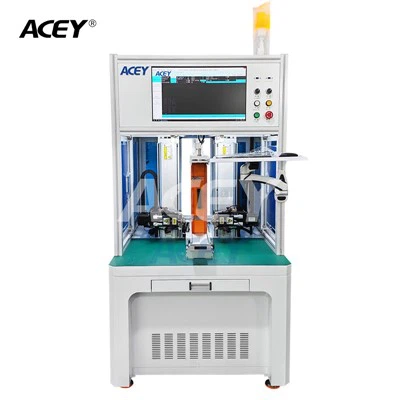
Hey there! I'm a supplier of Battery Pack Spot Welders, and today I wanna dig into a super important topic: what's the effect of the welding time on the battery pack's internal resistance?
Let's start by getting a basic understanding of battery packs and internal resistance. A battery pack is made up of multiple individual batteries connected together, and internal resistance is like an invisible roadblock inside the battery that resists the flow of electric current. You see, minimizing this internal resistance is crucial because it directly affects the battery pack's performance. Low internal resistance means less energy loss as heat, better efficiency, and longer battery life.
Now, welding plays a huge role in putting together a battery pack. That's where our Spot Welding Machine for Battery Pack comes in super handy. Spot welding is a process where we use a high - intensity electric current to join two or more metal pieces together at specific points. In the context of battery packs, we're usually welding battery tabs to the battery cells.
So, how does welding time fit into all of this? Well, welding time is the duration for which the welding current is applied during the spot - welding process. It might seem like a simple variable, but it can have a big impact on the internal resistance of the battery pack.
Short Welding Time
When we use a short welding time, the heat generated during the welding process is limited. This can lead to a phenomenon called "cold welding." In cold welding, the metal parts don't fully melt and fuse together. Instead, they just sort of stick on a surface - level.
The immediate consequence of this is a higher contact resistance between the welded parts. In a battery pack, when the tabs are poorly welded to the cells due to short welding times, the electrons have a harder time flowing from one part to another. This is like trying to drive on a bumpy, narrow road – the traffic (in this case, the electric current) slows down.
For example, if you're using our 18650 Battery Manual Spot Welding Machine and you set the welding time too low, you might notice that the battery pack gets warm quickly during use. This is because the extra resistance is causing the battery to lose energy in the form of heat. And over time, this higher internal resistance can also reduce the battery pack's capacity and overall performance. The battery might not be able to deliver the same amount of power as it's supposed to, and it will discharge faster.


Long Welding Time
On the other hand, using a long welding time can also cause problems. When the welding time is too long, excessive heat is generated. This can lead to over - melting of the metal parts. In the case of battery packs, the excessive heat can damage the battery cells themselves.
The battery cells have very sensitive internal components, and too much heat can cause their chemical composition to change. This can increase the internal resistance of the individual cells, which then contributes to a higher overall internal resistance of the battery pack.
Another issue with long welding times is that it can cause the formation of large, uneven weld spots. These uneven spots can create stress points in the welded joint. As the battery pack expands and contracts during charge and discharge cycles, these stress points can lead to cracks in the welds. Once the welds start to crack, the contact resistance shoots up, and the battery pack's performance takes a nosedive.
Optimal Welding Time
So, what's the sweet spot? Finding the optimal welding time is a bit like walking a tightrope. It depends on a few factors, such as the type of battery cells (e.g., 18650, 21700), the thickness of the battery tabs, and the material of the tabs.
Generally, you want to use a welding time that's just long enough to create a good, solid weld without causing too much heat damage. For most common battery pack applications using 18650 cells and standard - thickness nickel tabs, our customers have found that the optimal welding time can be determined through some trial and error. Our Spot Welding Machine for 18650 Battery comes with adjustable settings to make it easier for you to find that perfect welding time.
When you achieve the optimal welding time, the internal resistance of the battery pack is minimized. The electrons can flow smoothly from the battery cells through the tabs and into the rest of the circuit. This means that the battery pack can operate more efficiently, deliver more power, and have a longer lifespan.
Testing and Monitoring
To make sure you're getting the best results, it's important to test and monitor the internal resistance of your battery packs during the manufacturing process. There are special devices available that can measure the internal resistance of a battery pack accurately. By regularly testing the battery packs, you can adjust the welding time if you notice any changes in the internal resistance.
This continuous improvement process is crucial for producing high - quality battery packs. And our Battery Pack Spot Welders are designed to help you in this process by providing consistent, reliable welding with adjustable settings so that you can dial in the perfect welding time.
Conclusion
In conclusion, the welding time has a significant effect on the battery pack's internal resistance. Both too short and too long welding times can lead to increased internal resistance, which in turn affects the battery pack's performance and lifespan. As a Battery Pack Spot Welder supplier, we understand the importance of this variable and have designed our products to help you achieve the optimal welding time.
Whether you're a small - scale DIY enthusiast building your own battery packs or a large - scale manufacturer, we have the right Spot Welding Machine for you. We're here to support you in producing high - quality battery packs with low internal resistance.
If you're interested in our products or have any questions about finding the right welding time for your battery packs, don't hesitate to reach out for a chat. We're looking forward to discussing how we can help you with your battery - packing needs.
References
- Linden, D., & Reddy, T. B. (2002). Handbook of Batteries. McGraw - Hill.
- Burke, A. F. (2007). Battery and Ultracapacitor Selection, Modeling, Simulation and Application for Electric, Hybrid Electric and Fuel Cell Vehicles. Journal of Power Sources, 168(2), 269 - 280.