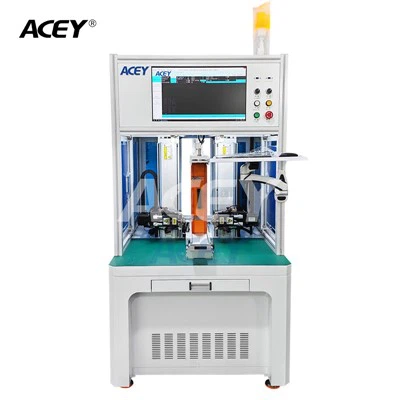
A battery sorting machine is an essential piece of equipment in the battery manufacturing and recycling industries. As a leading supplier of Automatic Battery Sorting Machine, Lithium Cell Sorting Machine, and Battery Sorting Machine, we understand the importance of these machines and their working principles. In this blog, we will delve into the details of how a battery sorting machine operates.
The Basics of Battery Sorting
Battery sorting is the process of categorizing batteries based on various parameters such as capacity, voltage, internal resistance, and state of charge. This is crucial for several reasons. In the manufacturing process, sorting ensures that only batteries with similar characteristics are grouped together, which is essential for creating battery packs with consistent performance. In the recycling industry, sorting helps in separating different types of batteries for proper recycling and disposal.
The Working Principle of a Battery Sorting Machine
1. Loading and Feeding
The first step in the operation of a battery sorting machine is the loading and feeding of batteries. Batteries are typically placed in a hopper or a feeding system at the beginning of the machine. This system is designed to handle different types and sizes of batteries, ensuring a smooth and continuous flow of batteries into the sorting process.
For example, in our Automatic Battery Sorting Machine, the feeding system is equipped with sensors that can detect the presence and position of batteries. This allows for precise control of the feeding rate and ensures that each battery is properly aligned for the subsequent sorting steps.
2. Parameter Measurement
Once the batteries are loaded and fed into the machine, the next step is to measure their key parameters. The most common parameters measured in a battery sorting machine are voltage, capacity, and internal resistance.
- Voltage Measurement: Voltage is one of the most basic and important parameters of a battery. Measuring the voltage of a battery can provide information about its state of charge and overall health. In a battery sorting machine, voltage is typically measured using voltage sensors. These sensors are connected to the battery terminals and can accurately measure the voltage across the battery.
- Capacity Measurement: Battery capacity refers to the amount of charge a battery can store. Measuring the capacity of a battery is more complex than measuring voltage. It usually involves discharging the battery at a constant current and measuring the time it takes to reach a certain voltage level. In our Lithium Cell Sorting Machine, advanced algorithms and high - precision current sources are used to accurately measure the capacity of lithium cells.
- Internal Resistance Measurement: Internal resistance is an important parameter that affects the performance and efficiency of a battery. A high internal resistance can lead to increased heat generation and reduced battery life. Measuring internal resistance typically involves applying a small current pulse to the battery and measuring the resulting voltage change. In a battery sorting machine, specialized internal resistance measurement circuits are used to obtain accurate internal resistance values.
3. Data Processing and Analysis
After the parameters of the batteries are measured, the data is sent to a control system for processing and analysis. The control system is usually equipped with a microprocessor or a computer that can perform complex calculations and comparisons.
The control system compares the measured parameters of each battery with pre - set criteria. These criteria are based on the specific requirements of the battery application. For example, if the batteries are to be used in a high - performance battery pack, the control system will sort out the batteries that meet the strict voltage, capacity, and internal resistance requirements.


4. Sorting and Discharging
Based on the results of the data processing and analysis, the batteries are sorted into different categories. Each category corresponds to a specific range of parameter values. The sorting process is usually carried out using mechanical or pneumatic sorting mechanisms.
- Mechanical Sorting: Mechanical sorting mechanisms use conveyor belts, chutes, and gates to direct the batteries to different collection bins based on their sorted category. For example, a gate can be opened or closed to divert a battery to the appropriate bin depending on its measured parameters.
- Pneumatic Sorting: Pneumatic sorting mechanisms use compressed air to move the batteries. Compressed air jets can be used to push the batteries into different collection bins. This method is particularly suitable for sorting small and lightweight batteries.
In addition to sorting, some battery sorting machines also have a discharging function. Batteries that are over - charged or have an abnormal state of charge can be discharged to a safe level before being sorted or recycled.
5. Quality Control and Monitoring
Throughout the sorting process, quality control and monitoring are essential. The battery sorting machine is equipped with sensors and monitoring systems that can detect any abnormal conditions or errors. For example, if a battery fails to be measured correctly or if there is a problem with the sorting mechanism, the monitoring system will send an alarm signal.
Regular maintenance and calibration of the battery sorting machine are also crucial to ensure its accuracy and reliability. Our Battery Sorting Machine is designed with easy - to - access components and calibration procedures, making it convenient for users to maintain and operate the machine.
Applications of Battery Sorting Machines
Battery sorting machines have a wide range of applications in different industries:
- Battery Manufacturing: In the battery manufacturing industry, battery sorting machines are used to ensure the quality and consistency of battery products. By sorting batteries based on their parameters, manufacturers can produce high - performance battery packs that meet the strict requirements of various applications, such as electric vehicles, mobile devices, and energy storage systems.
- Battery Recycling: In the battery recycling industry, battery sorting machines are used to separate different types of batteries for proper recycling. Different types of batteries, such as lead - acid batteries, lithium - ion batteries, and nickel - metal hydride batteries, have different recycling processes. Sorting these batteries at the beginning of the recycling process can improve the efficiency and effectiveness of the recycling operation.
Why Choose Our Battery Sorting Machines
As a professional supplier of battery sorting machines, we offer several advantages:
- High Precision: Our machines are equipped with high - precision sensors and advanced measurement techniques, ensuring accurate parameter measurement and reliable sorting results.
- Customization: We understand that different customers have different requirements. Our battery sorting machines can be customized according to the specific needs of the customer, including the type of batteries to be sorted, the sorting criteria, and the production capacity.
- User - Friendly Design: Our machines are designed with user - friendly interfaces and easy - to - operate controls. This makes it easy for operators to set up, operate, and maintain the machines.
If you are in the market for a high - quality battery sorting machine, we invite you to contact us for more information and to discuss your specific requirements. Our team of experts is ready to provide you with professional advice and solutions to meet your battery sorting needs.
References
- "Battery Technology Handbook" by Thomas B. Reddy.
- "Lithium - Ion Batteries: Science and Technologies" edited by Gholam - Abas Nazri and Gianfranco Pistoia.
- Research papers on battery sorting and recycling from academic journals such as Journal of Power Sources.