


Cascade Utilization and Recycling of Waste Power Batteries
With the vigorous development of new energy vehicles, the consumption of power lithium batteries has increased rapidly, and the number of waste power batteries has also increased steadily. Power batteries contain abundant valuable metal resources such as lithium, nickel, cobalt, iron, and copper. The development of short-range and efficient power battery recycling and reuse technology can not only effectively reduce the demand for key material resources, but also solve major problems such as environmental pollution and ecological impact.
There are currently two main feasible treatment methods for waste power batteries:
One is cascade utilization, that is, retired power lithium batteries are used in other fields such as energy storage as carriers of electric energy, so as to give full play to the surplus value.
The second is recycling, that is, the waste power batteries are disassembled, crushed, sorted, smelted (or material repaired), etc., and the process of resource utilization is carried out.
Affected by recycling technology and safety issues, only lithium iron phosphate batteries can play their surplus value through cascade utilization, and batteries with ternary materials are still mainly recycled.
Cascade Utilization
The so-called secondary utilization is the repeated reuse of batteries on the basis of mild scrapping. Waste power batteries do not mean that the power batteries are completely scrapped. Batteries with a remaining capacity of 80% or less still have utilization value. These batteries cannot be used in new energy vehicles, but the batteries themselves are not scrapped. They can be recycled, screened, and reused in other fields. Typical applications are energy storage fields, such as wind and solar energy storage, peak shaving and valley filling, backup power supply, and household power regulation.
In terms of the current market situation, compared with ternary batteries, lithium iron phosphate batteries are more suitable for secondary utilization. The capacity of lithium iron phosphate batteries tends to decay slowly with the increase of the number of cycles. When the battery capacity decays to 80%, the lithium iron phosphate batteries retired from the car still have a large number of cycles and have a higher secondary utilization value. At present, there is limited room for improvement in the performance and cost of lithium iron phosphate batteries, so lithium iron phosphate batteries will be more suitable for and ahead of ternary batteries in the secondary utilization of the energy storage industry. In addition, lithium iron phosphate batteries do not contain metals such as cobalt, lithium, and nickel, and have a low resource value. Therefore, lithium iron phosphate batteries generally continue to be used as energy storage batteries.
Recycling
The recycling of waste power batteries refers to the dismantling of recycled waste power batteries and the reuse of rare metals by refining them, which is the resource processing of waste power batteries. The recycling of waste power batteries is mainly aimed at power batteries with serious capacity loss and cannot be used anymore. They can only be disassembled to recover valuable resources, such as rare metals such as cobalt and nickel. Extracting valuable metals such as nickel, cobalt, and lithium from waste power batteries for recycling can avoid the risks of upstream raw material scarcity and price fluctuations to a certain extent and reduce the production cost of power batteries.
At present, the recycling method of waste power batteries in the market is mainly based on reuse. On the one hand, the cascade utilization of waste power batteries requires relevant technical accumulation and relevant experimental verification, which is still immature and still under exploration; on the other hand, the number of waste power batteries is still small, and it is difficult to scale up the cascade utilization. However, before the cascade utilization, we can conduct a series of tests on lithium batteries for subsequent development.
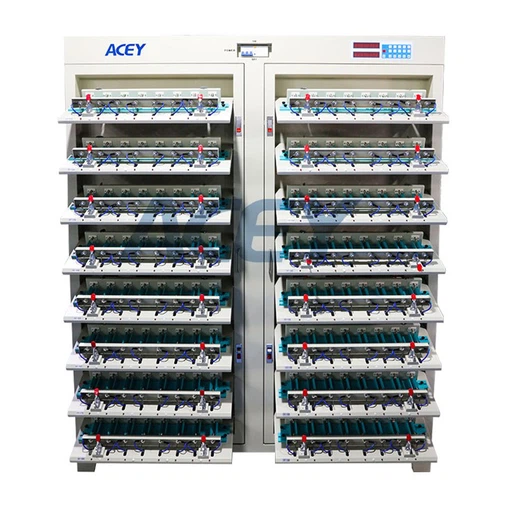
1. Battery health assessment technology:
Battery health assessment technology is an accurate estimation of the battery status, including state of charge, SOC, state of health, SOH and remaining useful life, RUL. Battery capacity tester is a device specially used for lithium battery performance testing. It evaluates key parameters such as battery capacity through charge and discharge tests, and classifies and screens batteries. We can use the capacity cabinet to test lithium batteries to provide support for subsequent battery use.
2. Battery recombination and matching technology:
Battery recombination and matching technology refers to the recombination of battery cells of different capacity and performance into new battery packs to meet the needs of specific applications, including matching, balancing and optimization of management systems of battery cells. Lithium battery PACK is a battery combination system that combines single or multiple lithium battery cells in series and parallel, and is equipped with necessary protection circuits, housings and connection devices to meet specific application requirements. Lithium battery Pack is widely used in electric vehicles, energy storage systems, aerospace, power tools and other fields, and can provide reliable energy solutions for various industries.
Acey new energy is a professional supplier specialized in Lithium Battery Pack Assembly Machine, such as battery insalution paper sticking machine, battery sorting machine, battery spot welding machine, battery comprehensive tester, battery pack charge and discharge aging tester, etc and we provide one-stop solution for cylindrical battery pack assembly line. If any interested, please feel free to contact us.

3. Improvement of battery management system (BMS):
Battery management system plays a key role in secondary use. BMS can be reprogrammed to adapt to different charging and discharging strategies and safety requirements. At the same time, we can use Bms tester to test BMS. Battery management system (BMS) plays a key role in ensuring the safe and efficient operation of batteries, and Bms testing equipment is an important guarantee to ensure the reliable performance of BMS.


