Differences Between Lithium Battery Stacking and Winding Processes
The stacking and winding processes of lithium batteries are two different cell assembly technologies, which occupy a core position in the middle cell assembly process of battery manufacturing. The following is an introduction to the two processes and their main differences, characteristics, etc.
Wound lithium-ion cells are usually composed of positive and negative electrode sheets, diaphragms, pole ears, current collectors and other components. During the production process, we will use battery winding machine to operate. First, two layers of metal pole ears are clamped around the pole ear part of a layer of current collector for welding, and then the multiple layers of metal pole ears are welded together with the positive pole ears or negative pole ears of the lithium battery, and further bonded according to the design requirements. Then the positive and negative electrode sheets and diaphragms are stacked in a certain sequence, and then a specific tension and pressure are applied to form a spiral structure, and finally the winding manufacturing of the cell is completed, which is mainly used for the production of prismatic and cylindrical lithium batteries.

The details are as follows:
1. Welding pole ears
The positive electrode sheet of the wound lithium-ion cell uses an aluminum pole ear, while the negative electrode sheet uses a nickel pole ear. First, the two tabs need to be connected to the current collector through an ultrasonic metal spot welder, and the negative electrode sheet needs to be specially treated.
2. Prepare the pole sheet and separator
The prepared positive and negative pole sheets and separators need to be cut and bonded according to the design requirements.
3. Arrangement and winding
The positive pole sheet, separator, negative pole sheet and separator are arranged in the prescribed order, and the winding is completed under the action of pressure and tension. After the winding is completed, the explosion-proof sheet is pressed on both ends of the current collector to enable the battery cell to operate more safely.
The main advantages of the winding process are its high production efficiency and low production cost. Because the process is mature and battery winding machine and its operating technology are very standardized, it is easy to realize automated production. In addition, the winding process also performs well in improving the consistency and reliability of the battery, which makes it very suitable for large-scale production.
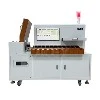
The stacking process refers to the assembly method of constructing lithium-ion batteries by stacking components such as positive pole sheets, separators and negative pole sheets layer by layer. The stacked lithium-ion battery cell adopts an inward-facing structure of the pole ears, so that the internal space of the battery cell can be maximized. The lamination process can generally be divided into stacking type and folding type. In the production process, we will use battery stacking machine for operation.
Compared with cylindrical winding, the lamination winding process requires higher tension control, so the prismatic battery winding machine is more technically difficult. In the winding process, it is necessary to monitor whether the pole piece or diaphragm is damaged, whether there are metal foreign bodies on the surface of the material, the misalignment value of the pole piece double-sided coating, the incoming defective products, the folding and folding of the pole ear, etc. The lamination is mainly used in the production of polymer lithium batteries.

The details are as follows:
1. Preparation of pole pieces and diaphragms
Like wound lithium-ion cells, various components such as positive and negative pole pieces and diaphragms need to be prepared in laminated lithium-ion cells.
2. Arrangement and stacking
The positive pole piece, diaphragm and negative pole piece are stacked in sequence in the prescribed order, and layered at the pole ear. Then the stacked components are compressed to complete the manufacture of the battery cell.
The technical advantages of the lamination process are mainly reflected in its high space utilization and good structural stability. Since the pole pieces are stacked, the space inside the battery can be used more effectively, increasing the energy density. In addition, the presence of battery stacking machine in production can also reduce the internal stress of the battery during the charging and discharging process, thereby extending the cycle life of the battery.
With the advancement of technology, the efficiency and cost-effectiveness of the stacking process are expected to be further improved, and it may occupy a larger share in the future lithium battery market. At the same time, the winding process is also being continuously optimized to improve performance and reduce costs through structural improvements and the application of new materials.
Acey new energy is a professional supplier specialized in Lithium Battery Lab Machine, Battery Material, Battery Pack Assembly Machine and we provide one-stop solution for cylindrical battery pack assembly line and lithium ion battery manufacturing equipment.If any interested,please feel free to contact us.