Batteries are everywhere in our lives: button batteries in car keys, AA batteries in flashlights, lead-acid batteries in electric vehicles, lithium batteries in new energy vehicles. The wide variety of battery types and technical jargon can leave many people confused.
Actually, battery classification and selection isn't that complicated. Leaving aside the complex manufacturing processes and chemical principles, focusing on application scenarios makes it easy to distinguish the differences, uses, and advantages/disadvantages of various batteries.
Basic Classification: Understanding Primary and Secondary Batteries
The core classification of all batteries follows one standard: whether they can be recharged and reused. This categorizes them into primary and secondary batteries. This is the foundation for understanding all batteries; remembering this classification is half the battle.
Disposable Batteries: Designed for Low-Power Scenarios
Primary batteries, also called non-rechargeable batteries, undergo irreversible chemical reactions. Once depleted, they must be discarded and cannot be recharged. The core advantages of this type of battery are its low price, small size, and low self-discharge rate. It's suitable for devices with low power consumption, occasional use, and no need for frequent charging, making it the most "worry-free" battery in our daily lives.
The two most common types of primary batteries we encounter daily are:
1. Button Battery: The "Standby Master" for Car Keys and Electronic Devices
The button batteries in our car keys, smartwatches, and blood glucose meters are primarily lithium-manganese dioxide batteries, commonly CR2032 and CR2025. "CR" indicates the lithium/manganese dioxide chemical system. Its characteristics perfectly suit its usage scenarios: a nominal 3V high voltage, extremely low self-discharge rate (still has power after three to five years), small size (doesn't take up much space), and remarkably stable performance. These advantages allow it to meet the needs of devices like car keys and smartwatches that require long standby times and occasional discharge.
2. AA/AAA Batteries: Essentials for Flashlights and Remote Controls
The AA/AAA batteries used in flashlights, TV remotes, and children's toys mainly come in two types, and a "generational replacement" pattern has long been established:
Carbon Zinc-Manganese Batteries
The cheapest dry cell batteries, but with significant drawbacks-low capacity, unsuitable for high-current discharge, and prone to leakage that can damage devices. They are gradually being phased out of the market.
Alkaline Zinc-Manganese Batteries
The current mainstream choice, and the main product of brands like Nanfu and Changhong. Compared to carbon-zinc batteries, they offer several times more capacity, more stable performance, and can be used with low-power, high-current devices. Their price is also moderate, perfectly meeting the needs of everyday small devices like flashlights and remote controls.
A small reminder: Rechargeable AA/AAA batteries are also available on the market. These are actually secondary batteries, primarily nickel-metal hydride batteries, not primary batteries. They are suitable for devices that require frequent battery replacements, saving considerable costs.
Rechargeable Batteries: The "Energy Core" of Power Devices
Rechargeable batteries, also known as secondary batteries, have reversible internal chemical reactions. By charging, the active materials can regain their performance, allowing for repeated use. The core advantages of these batteries are high energy density and high discharge power, making them suitable for devices that require repeated charging and a continuous supply of large amounts of energy. From electric bicycles to electric cars, from mobile phones to energy storage power stations, all rely on the support of rechargeable batteries.
Common rechargeable batteries in our daily lives, from classic to trendy, mainly include lead-acid batteries and lithium-ion batteries, as well as the more recently popular graphene batteries, sodium-ion batteries, and solid-state batteries. We will break them down one by one for easy understanding.
Among rechargeable batteries, lead-acid batteries and lithium-ion batteries are currently the most widely used "main force." One emphasizes low cost and stable performance, while the other emphasizes high performance and adaptability to multiple scenarios. They occupy different market segments and continue to play important roles in their respective fields.
Lead-acid batteries: The "old friend" of electric bicycles
Lead-acid batteries are one of the most classic rechargeable batteries and the most common type of battery used in electric bicycles. The technology has been developing for decades and is very mature. The battery pack assembly line for electric bike is also becoming popular in some countries at present. Core advantages: low manufacturing cost, ability to achieve high current discharge, good starting and acceleration performance, relatively high safety, and low maintenance and replacement costs, making them suitable for price-sensitive scenarios. Significant disadvantages: extremely low energy density, large and heavy battery size, short cycle life (generally showing significant degradation after about 300 charge-discharge cycles), and the presence of heavy metals such as lead and sulfuric acid, making them environmentally unfriendly and requiring high recycling standards. Current status: In the new national standard electric bicycles, lead-acid batteries are gradually being replaced by lighter and longer-lasting lithium batteries. However, they still hold a place in older electric bicycles, low-speed commuter vehicles, and cost-conscious logistics vehicles and tricycles, due to their cost-effectiveness.
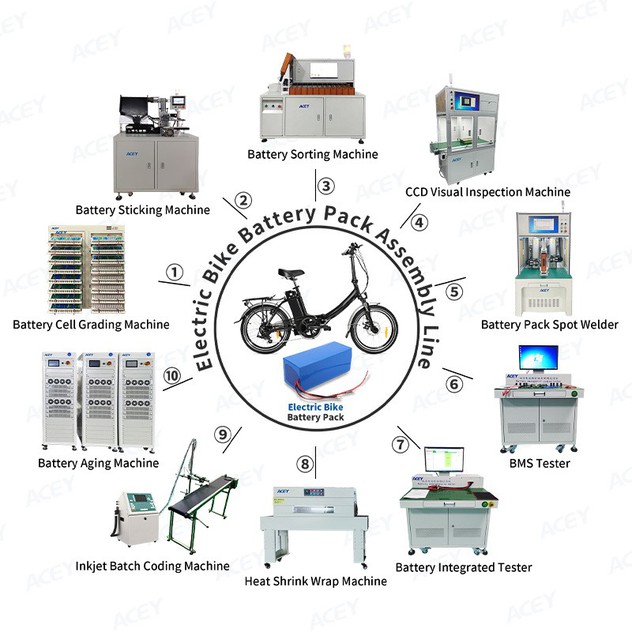
Lithium-ion Batteries: The "Core Power" of New Energy Vehicles
Lithium-ion batteries are now the "star batteries," with applications everywhere from mobile phones and laptops to electric vehicles and energy storage power stations, especially in the field of new energy vehicles where they are the absolute mainstream. It's not a single type, but a "large family" with multiple technical routes to adapt to different usage needs. Among them, lithium iron phosphate batteries and ternary lithium batteries are the two core types.

1. Lithium Iron Phosphate Batteries
Lithium iron phosphate batteries are currently the "main force" of new energy vehicles, especially in some mid-to-low-end models, which almost all use this battery. Core advantages: Extremely high safety, with a much higher thermal runaway trigger threshold than other lithium batteries; extremely long cycle life, achieving more than 3000 charge-discharge cycles, easily lasting seven or eight years of daily use; and low raw material costs, making the battery more affordable. Minor disadvantages: Relatively lower energy density, resulting in slightly shorter driving range for the same weight; slightly poorer low-temperature performance, with some range reduction in winter.
2. Ternary Lithium Batteries
Ternary lithium batteries are mainly divided into lithium nickel cobalt manganese oxide (NCM) and lithium nickel cobalt aluminum oxide (NCA) routes. They are the preferred choice for high-end, long-range new energy vehicles, and are widely used in high-end models from brands like Tesla and NIO. Core advantages: High energy density, providing longer driving range for the same volume and weight; excellent low-temperature performance, maintaining good discharge performance even in winter; good rate performance; and faster charging and discharging speeds. Minor disadvantages: Higher manufacturing cost, resulting in higher battery prices; slightly lower thermal stability, requiring stricter thermal management systems; and slightly lower safety than lithium iron phosphate batteries.
Besides these two mainstream types, the lithium-ion battery family also includes lithium cobalt oxide batteries (mainly used in consumer electronics such as mobile phones and laptops) and lithium manganese oxide batteries (used in some specialized vehicles and energy storage scenarios). These represent trade-offs between performance, cost, and safety tailored to different application needs.
In short, remember these principles:
- For disposable, low-power devices, choose primary batteries-they're convenient and inexpensive.
- For devices that require repeated charging and power, choose rechargeable batteries; select lead-acid or lithium batteries depending on your budget and needs.
- For short-distance commuting and price sensitivity, choose lead-acid or graphene batteries.
- For new energy vehicles and those seeking long range, choose lithium iron phosphate or ternary lithium batteries.
- For those with extreme demands for safety and range, consider solid-state batteries-the future mainstream.
Battery technology is constantly evolving, from the initial dry cell batteries to today's solid-state batteries. Each upgrade is designed to better meet our daily needs. Hopefully, this article will help you understand the essence of various battery types.
about us
Acey New Energy is a provider of high-end equipment and complete production line solutions for the new energy battery field. We are committed to providing global battery manufacturers, research institutions, and innovative energy organizations with full-cycle services from experimental development to large-scale production. Whether it's laboratory-level sample production, pilot-scale process verification, or the planning and construction of large-scale production lines, we can provide one-stop support covering factory layout design, equipment R&D and manufacturing, on-site installation and commissioning, and operation training.