


In the modern electronics manufacturing industry, from smartphones and automotive electronics to new energy power batteries, almost all high-precision electronic products rely on a key technology for internal connections-wire bonding. The core equipment for this process is the wire bonding machine. While it may seem like just a "fine wire connection," it actually integrates materials science, precision control, and automation technology, making it an indispensable link in the electronics manufacturing supply chain.
So, how exactly does a wire bonding machine work? What are the underlying principles? And what process enables high-precision connections?
I. What is Wire Bonding?
Wire bonding is a technology that uses extremely fine metal wires to achieve electrical connections, primarily used to connect chips (dies) to packaging substrates or external pins. Simply put, its function is to "bring out" the internal circuitry of the chip, allowing it to transmit signals and connect to external systems.
Common wire bonding materials include gold, aluminum, and copper, with wire diameters typically ranging from 15 to 75 micrometers-fineer than a human hair. This minute size places extremely high demands on the precision and stability of the equipment.
II. Core Working Principle of Wire Bonding Machines
Many people mistakenly believe that wire bonding is a "molten connection" similar to traditional soldering, but this is not the case. Wire bonding machines essentially employ a solid-state bonding technology, using the combined effects of pressure, heat, and ultrasonic energy to achieve atomic bonding between two metals at the microscopic level, thus forming a strong metallurgical bond.
In this process: pressure causes plastic deformation of the metal surface; ultrasonic vibration breaks down the oxide layer on the metal surface; heat promotes atomic diffusion. Ultimately, the two metals achieve a strong bond without melting.
III. Complete Workflow of a Wire Bonding Machine
A fully automatic wire bonding machine typically operates at high speed and continuously. Its core workflow can be divided into the following steps:
1. Loading and Precise Positioning
First, the workpiece to be bonded (such as a chip or battery tab) is placed on the work platform. The equipment is fixed by a high-precision motion platform, and a CCD vision system is used to identify and correct the position of the bonding point, ensuring that the error in the bonding position is controlled within the micrometer range. This step directly determines the accuracy of the bonding and is an important foundation for ensuring product yield.
2. Wire Feeding Control
The wire bonding machine releases the thin metal wire from the spool and, through a conductor device and tension control system, stably feeds the wire to the bonding area. Constant tension must be maintained during the wire feeding process; otherwise, problems such as wire breakage, knotting, or misalignment can easily occur.
3. First Bond Formation (Ball Bond)
In the ball bonding process, the wire bonding machine first melts the end of the metal wire to form a tiny spherical structure (Free Air Ball) through electric spark or heating. The soldering tip then presses the metal ball onto the chip pad, simultaneously applying pressure, heat, and ultrasonic energy to form the first strong solder joint.
This solder joint, typically located on the chip, is the starting point of the entire connection, and its quality directly affects the stability of the entire circuit.
4. Loop Formation
After completing the first solder joint, the soldering tip moves to the second soldering position, simultaneously pulling out an arc-shaped conductor. This process is called "loop formation" or "arc forming."
The shape and height of the arc are not arbitrarily designed but precisely controlled to:
- Relieve stress caused by thermal expansion and contraction
- Improve shock resistance
- Prevent conductor breakage or short circuits
Therefore, the arc design of the solder wire plays a crucial role in reliability.
5. Second Solder Joint Formation (Stitch Bond / Wedge Bond)
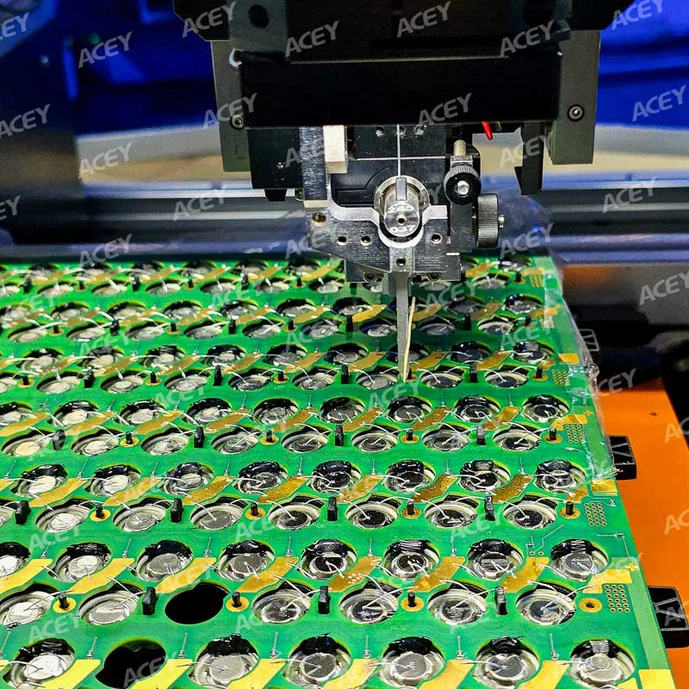
The soldering tip moves to the second connection point (such as a pin or tab) and completes the connection by applying pressure and ultrasonic energy again. This solder joint is typically wedge-shaped or flattened and is called a stitch bond or wedge bond.
At this point, a complete electrical connection path has been established.
6. Wire Cutting and Cyclic Operation
After welding, the equipment automatically cuts the metal wire and forms a new wire end, preparing it for the next welding operation. The entire process is usually completed in a very short time, enabling high-speed continuous production to meet the needs of large-scale manufacturing.
IV. Mainstream Wire Bonding Process Types
Depending on the process, wire bonding machines are mainly divided into two types:
1. Ball Bonding
- Primarily uses gold wire
- High precision and good stability
- Widely used in semiconductor packaging
Its characteristic is that a metal ball is formed first, and then welded.
2. Wedge Bonding
- Mostly uses aluminum or copper wire
- Lower cost
Suitable for power devices and the battery industry
Its characteristic is that the wires are directly pressed together, without the need to form a ball-shaped structure.
ACEY-3753A automatic wire bonder a high-precision welding system engineered for the assembly of power batteries, energy storage batteries, and various lithium‑ion battery modules. It is primarily used to create reliable connections between aluminum busbars and battery tabs.

V. Application Areas
Wire bonding technology is widely used in many high-end manufacturing fields, including:
Semiconductor Industry: Used for IC chip, LED packaging, and sensor manufacturing, it is one of the core processes of chip packaging.
New energy batteries: Used for electrode connections and internal conductive structure construction in power battery modules, cylindrical batteries, and pouch batteries.
Automotive electronics: Applied to IGBT modules, control systems, and various power electronic devices.
Consumer electronics: Such as mobile phone chips, camera modules, and smart wearable devices.
It can be said that wire bonding technology has become one of the fundamental connection methods in the modern electronics industry.
As electronic products develop towards miniaturization and high performance, the precision, speed, and stability of wire bonding machines are also constantly improving. In the future, it will continue to play an important role in the semiconductor, new energy, and high-end manufacturing fields.
about Us
Acey New Energy is a provider of high-end equipment and complete production line solutions for the new energy battery field. We are committed to providing global battery manufacturers, research institutions, and innovative energy organizations with full-cycle services from experimental development to large-scale production.


