


Why are there energy storage batteries and power batteries, even though they are both lithium batteries? Many people wonder about this. Here, we'll explain the differences between them.
Although both energy storage batteries and power batteries are typically based on lithium-ion technology (such as lithium iron phosphate or ternary lithium), their applications and requirements are vastly different, leading to significant differences in design, performance, and lifespan.
To put it simply, you can use an analogy:
Power batteries are like sprinters: prioritizing explosive power, speed, and agility (high power, high energy density). For example, many electric vehicle batteries now support fast charging; a slow charge takes 8 hours, while a fast charge can fully charge in just 30 minutes.
Energy storage batteries are like marathon runners: prioritizing endurance, stability, and cost-effectiveness (long lifespan, high safety, low cost). Below, we'll compare them in detail across several dimensions, as shown in the table below:
|
Feature |
Power Battery |
Energy Storage Battery |
|---|---|---|
|
Application Scenarios |
Electric vehicles (EVs), electric bicycles, power tools, and other mobile or driving equipment. |
Power generation side (solar/wind + storage), grid side (peak shaving & frequency regulation), user side (residential/commercial & industrial storage), telecom base station backup power, and other stationary applications. |
|
Core Requirements |
High energy density (long driving range) and high power density (fast acceleration and rapid charging). |
Long cycle life (daily charge/discharge over many years), high safety (significant impact in case of failure), and low cost. |
|
Energy Density |
Very high. Prioritized to reduce weight and increase driving range. |
Relatively low. As systems are stationary, weight and volume are less critical; energy density can be sacrificed for better safety and lifespan. |
|
Power Density |
High. Requires instant high current output for acceleration and climbing. |
Moderate. Except for frequency regulation scenarios, most applications require stable and relatively low power output. |
|
Cycle Life |
Typically 1,000–3,000 cycles (depending on chemistry; NMC is shorter, LFP is longer). Vehicle lifespan is about 8–15 years. |
Very high, typically >3,500 cycles, and can exceed 10,000 cycles. Energy storage systems are designed for 15–20 years. |
|
Charge/Discharge Rate |
High. Frequent fast charging and high-rate discharge (e.g., rapid charging, sudden acceleration). |
Low. Usually operates at low and stable rates (e.g., 0.5C or lower) to extend lifespan. |
|
Cost Sensitivity |
High. Battery cost directly impacts vehicle price and market competitiveness. |
Extremely high. The core competitiveness lies in levelized cost of storage, requiring the lowest possible battery cost. |
|
Operating Environment |
Complex: vibration, shock, and wide temperature range (-30°C to 50°C+). |
Relatively stable and controllable. Typically installed indoors or in containers with advanced thermal management systems. |
|
Battery Management System (BMS) |
Highly complex. Requires real-time monitoring of each cell, managing high-rate charge/discharge, and ensuring safety during dynamic vehicle operation. |
Focuses more on balancing and lifespan management. With a large number of cells (MWh scale), BMS must ensure consistency and optimize charge/discharge strategies. |
|
Mainstream Technologies |
Nickel Manganese Cobalt (NMC) batteries (for high energy density) and Lithium Iron Phosphate (LFP) batteries (for safety and longer lifespan, increasing market share). |
Predominantly Lithium Iron Phosphate (LFP) batteries due to their advantages in safety, lifespan, and cost, which align well with energy storage requirements. |
Lithium Ion Battery pack assembly line is widely used in power tools, smart homes, electric vehicles, photovoltaic energy storage, intelligent lighting, mobile power, small appliances and new energy vehicles, etc.

Although power batteries and energy storage batteries differ in many ways, the core principle of the cells is the same: both consist of a positive electrode, a negative electrode, a separator, and an electrolyte. However, there are significant differences in design and material selection. For example, power batteries require high-rate charge and discharge, necessitating the selection of positive electrode materials with better conductivity and a lower D50, while also incorporating conductive agents such as CNTs to improve performance.
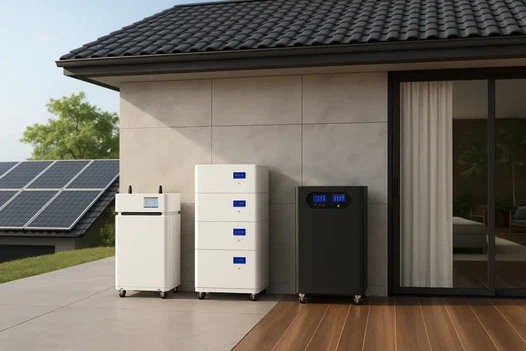
Furthermore, to achieve high rate of discharge, the compaction density and areal density cannot be too high. Currently, most energy storage cells are 280Ah or 314Ah, and are primarily stacked. Power batteries, on the other hand, come in both wound (cylindrical and prismatic) and stacked (prismatic) forms.
About Us
Acey New Energy is a provider of high-end equipment and complete production line solutions for the new energy battery field. We are committed to providing global battery manufacturers, research institutions, and innovative energy organizations with full-cycle services from experimental development to large-scale production. Whether it's laboratory-level sample production, pilot-scale process verification, or the planning and construction of large-scale production lines, we can provide one-stop support covering factory layout design, equipment R&D and manufacturing, on-site installation and commissioning, and operation training.


