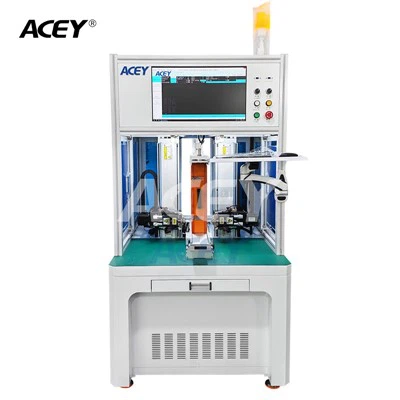
Integrating a CCD Testing Machine into an automated production line is a question that many manufacturers and production managers often ponder. As a supplier of CCD Testing Machine, I have witnessed firsthand the increasing demand for automation in various industries. In this blog post, I will explore the feasibility, benefits, challenges, and considerations of integrating a CCD Testing Machine into an automated production line.
Feasibility of Integration
The modern technology landscape has made it highly feasible to integrate a CCD Testing Machine into an automated production line. CCD (Charge - Coupled Device) technology has advanced significantly over the years. These machines use high - resolution cameras and intelligent image - processing algorithms to detect defects, measure dimensions, and perform other quality - control tasks with high precision.
Most contemporary CCD Testing Machines are designed with open - system architectures, which allow them to communicate with other production line equipment easily. This communication can be achieved through standard industrial protocols such as Ethernet/IP, Profibus, and Modbus. By leveraging these protocols, the CCD Testing Machine can exchange data with robots, conveyors, and other automation devices in real - time, enabling seamless integration.
For example, in the electronics manufacturing industry, where tiny components need to be inspected for defects such as cracks, misalignments, or incorrect markings, a CCD Testing Machine can be placed along the production line. It can receive components from a conveyor belt, perform the necessary inspections, and then communicate the results to a sorting mechanism that separates the good and bad parts.
Benefits of Integration
1. Increased Efficiency
One of the most significant advantages of integrating a CCD Testing Machine into an automated production line is the substantial increase in efficiency. Manual inspection processes are often time - consuming and prone to human errors. In contrast, a CCD Testing Machine can inspect products at high speeds, sometimes up to hundreds or even thousands of items per minute, depending on the complexity of the inspection task.
For instance, in the automotive industry, the inspection of engine components requires high - precision measurements and defect detection. By integrating a CCD Visual Inspection Machine into the production line, the inspection process can be completed much faster than manual inspection, reducing the overall production cycle time.
2. Improved Quality Control
Automated CCD Testing Machines can provide consistent and accurate inspection results. They are not affected by factors such as fatigue, distraction, or subjective judgment, which are common in manual inspection. This leads to a higher level of quality control in the production process.
In the battery manufacturing industry, a Cylindrical Cell Poles Visual Inspection Machine can detect even the slightest defects in the cell poles, such as scratches, dents, or incorrect dimensions. By integrating this machine into the production line, manufacturers can ensure that only high - quality battery cells are sent to the next production stage, reducing the number of defective products and improving customer satisfaction.
3. Data - Driven Decision Making
CCD Testing Machines can generate a large amount of inspection data, including defect types, frequencies, and locations. By integrating these machines into an automated production line, this data can be collected, stored, and analyzed in real - time. Manufacturers can use this data to identify trends, optimize production processes, and make informed decisions about quality improvement.
For example, if the data shows that a particular defect is occurring more frequently at a certain stage of the production process, manufacturers can take corrective actions such as adjusting the machine settings or replacing the worn - out parts.
Challenges of Integration
1. Compatibility Issues
One of the main challenges of integrating a CCD Testing Machine into an automated production line is ensuring compatibility with other equipment. Different manufacturers may use different communication protocols, software interfaces, and hardware standards. This can make it difficult to establish seamless communication between the CCD Testing Machine and other devices on the production line.
To overcome this challenge, it is crucial to work with a supplier who has experience in integrating CCD Testing Machines into diverse production environments. The supplier should be able to provide customized solutions and support to ensure compatibility with existing equipment.
2. Initial Investment
The initial investment required for integrating a CCD Testing Machine into an automated production line can be significant. This includes the cost of the CCD Testing Machine itself, as well as the cost of hardware and software upgrades, installation, and training.
However, it is important to view this as a long - term investment. The increased efficiency, improved quality control, and data - driven decision - making capabilities provided by the integration can lead to significant cost savings in the long run, such as reduced labor costs, lower defect rates, and improved productivity.
3. Maintenance and Calibration
CCD Testing Machines require regular maintenance and calibration to ensure accurate and reliable performance. In an automated production line, any downtime of the CCD Testing Machine can disrupt the entire production process. Therefore, it is essential to have a well - planned maintenance schedule and trained personnel to perform maintenance and calibration tasks.
Considerations for Integration
1. Production Line Layout
The layout of the production line is an important consideration when integrating a CCD Testing Machine. The machine should be placed in a location where it can easily receive the products to be inspected and where the inspection results can be smoothly communicated to the next equipment in the production process.
For example, if the products are transported on a conveyor belt, the CCD Testing Machine should be positioned perpendicular to the conveyor to ensure accurate inspection. The machine should also have enough space around it for maintenance and operator access.
2. Inspection Requirements
The specific inspection requirements of the products should be carefully considered. Different products may require different types of inspections, such as surface defect detection, dimensional measurement, or color inspection. The CCD Testing Machine should be selected and configured accordingly to meet these requirements.
For example, if the products have a high level of surface reflectivity, a CCD Testing Machine with a polarized light source may be required to reduce reflections and improve the inspection accuracy.


3. Software and Programming
The software used in the CCD Testing Machine plays a crucial role in the integration process. The software should be user - friendly and easy to program, allowing operators to quickly set up inspection parameters and modify them as needed.
It should also support data exchange and integration with other production line systems. For example, it should be able to export inspection data in a format that can be easily imported into the enterprise resource planning (ERP) system for further analysis.
In conclusion, integrating a CCD Testing Machine into an automated production line is not only feasible but also offers numerous benefits in terms of efficiency, quality control, and data - driven decision - making. Although there are challenges such as compatibility issues, initial investment, and maintenance requirements, these can be overcome with proper planning and support from a reliable supplier.
If you are considering integrating a CCD Testing Machine into your automated production line, I encourage you to reach out to our team for more information. We have extensive experience in providing customized CCD Testing Machine solutions that can seamlessly integrate with your existing production processes. Our experts will work closely with you to understand your specific requirements and provide the most suitable solutions. Contact us today to start the discussion and take your production to the next level.
References
- Smith, J. (2018). Industrial Automation: The Future of Manufacturing. Springer.
- Brown, A. (2020). CCD Imaging Technology for Quality Control in Production Lines. Journal of Manufacturing Technology, 15(2), 45 - 58.
- Johnson, R. (2019). Achieving Seamless Integration in Automated Production Systems. IEEE Transactions on Automation Science and Engineering, 12(3), 78 - 90.