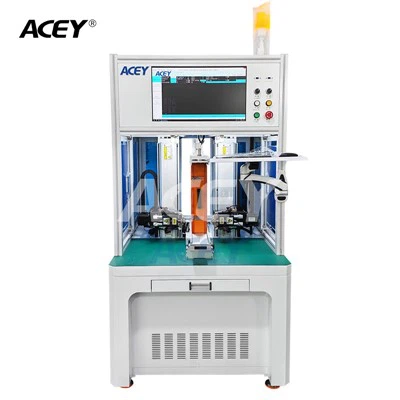
Hey there! As a supplier of Lithium Ion Cell Testers, I often get asked a bunch of questions about what these nifty devices can and can't do. One question that pops up quite a bit is, "Can a Lithium Ion Cell Tester measure the internal resistance of a cell?" Well, let's dive right into it and find out.
First off, let's understand what internal resistance is. In simple terms, internal resistance is like the "traffic jam" inside a battery cell. When current tries to flow through the cell, it encounters some resistance, just like cars on a busy road. This resistance can be caused by various factors, such as the materials used in the cell, the state of charge, and the temperature.
Now, why is measuring internal resistance important? Well, it's a key indicator of a battery's health and performance. A high internal resistance can mean that the battery is aging, damaged, or not performing as efficiently as it should. By measuring the internal resistance, we can get a better idea of how well the battery is working and whether it needs to be replaced or serviced.
So, back to the question at hand: Can a Lithium Ion Cell Tester measure the internal resistance of a cell? The short answer is yes, many modern Lithium Ion Cell Testers are capable of measuring internal resistance. But how do they do it?
There are a few different methods that Lithium Ion Cell Testers use to measure internal resistance. One common method is the AC impedance method. In this method, the tester applies a small AC signal to the battery cell and measures the resulting voltage and current. By analyzing the relationship between the voltage and current, the tester can calculate the internal resistance of the cell.
Another method is the DC load method. In this method, the tester applies a known DC load to the battery cell and measures the voltage drop across the cell. By using Ohm's Law (V = IR), the tester can calculate the internal resistance of the cell.
Both of these methods have their pros and cons. The AC impedance method is more accurate and can provide more detailed information about the battery's internal resistance. However, it requires more complex equipment and is generally more expensive. The DC load method is simpler and less expensive, but it may not be as accurate, especially for batteries with low internal resistance.
At our company, we offer a range of Lithium Ion Cell Testers that are capable of measuring internal resistance. Our 5V 200A Li Ion Battery Cell Testing Equipment is a great option for testing high-capacity lithium-ion battery cells. It uses the AC impedance method to provide accurate and detailed measurements of internal resistance.
If you're looking for a more affordable option, our 5V 10A 256Chs Battery Charge Discharge Test Equipment is a great choice. It uses the DC load method to measure internal resistance and is suitable for testing multiple battery cells simultaneously.
For those who need to test high-current battery cells, our 5V 1000A Battery Charge Discharge Tester is the way to go. It can handle high currents and provides accurate measurements of internal resistance, making it ideal for industrial applications.
Of course, measuring internal resistance is just one of the many features that our Lithium Ion Cell Testers offer. They can also measure other important parameters, such as voltage, current, capacity, and state of charge. By providing comprehensive testing capabilities, our testers can help you ensure the quality and performance of your lithium-ion battery cells.
In conclusion, a Lithium Ion Cell Tester can definitely measure the internal resistance of a cell. Whether you need a high-end tester for detailed analysis or a more affordable option for basic testing, we have the right solution for you. If you're interested in learning more about our Lithium Ion Cell Testers or have any questions, please don't hesitate to get in touch. We'd be happy to discuss your specific needs and help you find the perfect tester for your application.


References
- Battery Management Systems: Design by System Modeling and Hardware Implementation by Kai Peter Birke, Uwe Stimming, and Ralph E. White
- Lithium-Ion Batteries: Science and Technologies by Yoshio Nishi, Akihiro Ueda, and Masaki Yoshio