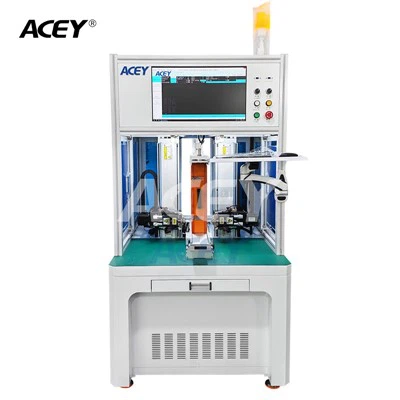
Hey there! As a supplier of Battery Sticking Machines, I often get asked if it's easy to train workers to operate these machines. Well, let's dive right into it and explore this question together.
First off, I've gotta say that the complexity of training really depends on a few key factors. One of the biggest factors is the type of battery sticking machine we're talking about. We've got different models for various battery types. For instance, the Battery Insulation Paper Pasting Machine For 32140 33140 is designed specifically for those 32140 and 33140 batteries. It has its own set of features and requirements. And then there's the Battery Barley Paper Sticking Machine For 18650 21700 26650 32650 32700, which is tailored for different battery sizes like 18650, 21700, and so on. Each machine has its idiosyncrasies, so the training process isn't going to be the same across the board.
Let's talk about the basic aspects of operating a battery sticking machine. Generally, these machines have a set of controls and functions that workers need to understand. The good news is that most modern battery sticking machines, like the ones on our Battery Sticking Machine page, are designed with user - friendliness in mind. You've got buttons and indicators that are relatively straightforward to read. For the most part, workers can quickly learn how to turn the machine on and off, adjust basic settings like speed and pressure.
But here's where things can get a bit tricky. One of the challenges in training is ensuring that workers understand the importance of precision. When you're sticking insulation paper or barley paper on a battery, even a tiny misalignment can cause big problems down the line. The paper has to be placed at the exact right position and with the right amount of pressure. This requires a bit of practice and a good eye for detail.
We usually start our training by giving workers a theoretical overview of how the machine works. We explain the different components, like the paper feeding system, the sticking mechanism, and the control panel. This helps them build a mental model of the machine and understand how all the parts interact. After that, it's hands - on time! We let them operate the machine under supervision. They start with simple tasks, like running the machine without actual batteries to get a feel for the controls.
As they get more comfortable, we gradually introduce real batteries. They learn how to load the batteries correctly, how to adjust the settings based on the battery type and the paper requirements. We also teach them about maintenance. It's crucial that workers know how to clean the machine, check for wear and tear on parts, and do basic troubleshooting. A well - maintained machine not only operates more efficiently but also has a longer lifespan.
Another factor that affects the ease of training is the workers' prior experience. If they've worked with similar machinery before, they'll likely pick up the operation of the battery sticking machine much faster. They already understand basic mechanical concepts and are familiar with control panels. On the other hand, if they're completely new to this kind of equipment, they'll need more time and patience.
We also find that the learning curve can vary from person to person. Some workers are quick learners and can master the machine in a matter of a few days. They're able to adapt to new situations and figure out how to solve problems on their own. Others might take a bit longer, but with consistent training and support, they can also become proficient operators.
One of the things we do to make the training process more effective is to provide detailed training manuals. These manuals are like a step - by - step guide. They have pictures and diagrams that show exactly how to do each task, from setting up the machine to performing maintenance. We also offer on - site training, where our experts go to the client's facility and train the workers directly. This way, we can address any specific questions or concerns that the workers might have.
In addition to the basic operation, we also teach workers about safety procedures. Battery sticking machines involve moving parts and electrical components, so safety is a top priority. We show them how to use personal protective equipment (PPE), like gloves and safety glasses. We also educate them on how to avoid dangerous situations, like getting their fingers caught in the machine or exposing themselves to electrical hazards.
So, is it easy to train workers to operate a battery sticking machine? Well, it's not impossible by any means. With the right approach, proper training materials, and a bit of patience, most workers can learn to operate these machines effectively. However, it's not a walk in the park either. There are skills to be learned, precision to be mastered, and safety procedures to be followed.
If you're in the market for a battery sticking machine and are worried about the training process, don't be! We're here to support you every step of the way. Our team of experts can provide comprehensive training and after - sales support. Whether you're a small business just starting out or a large corporation looking to upgrade your battery production line, we've got the right machine and the right training solutions for you.
If you're interested in learning more about our Battery Sticking Machine or would like to discuss your specific requirements, please reach out to us. We're eager to have a chat with you and help you find the perfect solution for your battery production needs.
References:


- Industry best practices in battery manufacturing equipment training
- Internal training documentation and experience as a Battery Sticking Machine supplier