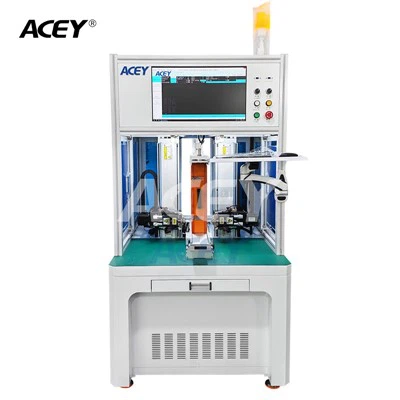
Hey there! As a supplier of battery testing systems, I often get asked about the maximum voltage these systems can handle. It's a crucial question, especially for those in the battery industry who need to ensure accurate and safe testing of their products. So, let's dive right in and explore this topic.


First off, the maximum voltage a battery testing system can handle varies widely depending on the specific model and its intended use. There are different types of battery testing systems out there, each designed to meet the needs of various battery chemistries, sizes, and applications. Some systems are built for low - voltage batteries, like those used in small consumer electronics, while others are capable of handling high - voltage batteries found in electric vehicles and large energy storage systems.
For low - voltage applications, we have some great options. Take our 5V 6A Battery Charge Discharge Test Equipment. This little guy is perfect for testing small batteries with relatively low voltage requirements. It can accurately measure the charge and discharge characteristics of batteries operating at up to 5 volts. It's a reliable choice for testing things like AA, AAA, and other small rechargeable batteries commonly used in toys, remote controls, and small gadgets.
If you're dealing with slightly higher current and still in the low - voltage range, our 5V 40A Polymer Battery Charge Discharge Capacity Tester is a great option. Polymer batteries are widely used in smartphones, tablets, and other portable devices. This tester can handle up to 5 volts and 40 amps, allowing you to thoroughly test the capacity and performance of these types of batteries. It provides detailed data on charge and discharge cycles, which is essential for quality control and research and development.
Now, for larger prismatic lithium - ion batteries, we offer the 5V 60A Prismatic Li Ion Battery Capacity Tester. Prismatic lithium - ion batteries are commonly used in electric vehicles, power tools, and large energy storage systems. This tester can handle up to 5 volts and 60 amps, giving you the ability to accurately measure the capacity and performance of these high - power batteries. It's equipped with advanced sensors and software that can provide in - depth analysis of the battery's behavior during charging and discharging.
But what about high - voltage battery testing? Well, there are specialized battery testing systems that can handle much higher voltages. For example, in the electric vehicle industry, batteries can have voltages ranging from 200 volts to over 800 volts. Our high - end battery testing systems are designed to handle these high - voltage batteries safely and accurately. These systems are built with robust insulation and protection mechanisms to prevent electrical hazards. They also have advanced control algorithms to ensure precise testing and monitoring of the battery's performance.
When determining the maximum voltage a battery testing system can handle, several factors come into play. One of the most important factors is the insulation and isolation of the system. The testing system needs to be able to withstand the high voltage without any electrical breakdown or leakage. This requires high - quality insulation materials and proper design.
Another factor is the power handling capacity of the system. Higher voltage batteries often have higher power requirements, so the testing system needs to be able to supply and dissipate the necessary power during the testing process. This involves having a powerful power supply and efficient cooling mechanisms to prevent overheating.
The accuracy of the measurement is also crucial. A good battery testing system should be able to measure the voltage, current, and other parameters accurately, even at high voltages. This requires high - precision sensors and calibration procedures.
In addition to the technical aspects, safety is always a top priority. Battery testing can be dangerous, especially when dealing with high - voltage batteries. Our battery testing systems are equipped with multiple safety features, such as over - voltage protection, over - current protection, and short - circuit protection. These features ensure that the testing process is safe for both the operator and the battery being tested.
So, if you're in the market for a battery testing system, it's important to consider your specific needs. Think about the type of batteries you'll be testing, the voltage range, the current requirements, and the level of accuracy you need. Whether you're a small battery manufacturer, a research institution, or an electric vehicle company, we have a battery testing system that can meet your needs.
If you have any questions about our battery testing systems or need help choosing the right one for your application, don't hesitate to reach out. We're here to assist you in finding the perfect solution for your battery testing requirements. Contact us today to start a conversation about your battery testing needs and let's work together to ensure the quality and performance of your batteries.
References
- Battery Testing Handbook, published by Battery Testing Institute
- High - Voltage Battery Systems in Electric Vehicles, research paper by Automotive Research Group
- Standards for Battery Testing Equipment, issued by International Battery Testing Association