Lithium-ion battery fires are mainly caused by mechanical, electrical, or thermal abuse, which can trigger internal short circuits and thermal runaway. Heat-generating reactions and oxygen released by certain cathode materials can intensify combustion, while residual heat inside cells can cause reignition even after visible flames are extinguished.
Although thermal runaway risks cannot be completely eliminated, battery testing-including capacity, internal resistance, self-discharge, cell consistency, lithium plating, and BMS protection testing-helps identify potential risks and improve battery safety.
Key Takeaways
Main Causes: Mechanical, electrical, and thermal abuse can trigger internal short circuits, side reactions, and thermal runaway.
Temperature Variations: Thermal runaway temperatures vary with battery chemistry, SOC, materials, and cell design; no universal temperature sequence applies.
Oxygen and Fire Suppression: Oxygen released by certain cathode materials can intensify internal reactions. External suppression may extinguish visible flames but cannot necessarily stop internal reactions.
Risk of Reignition: Residual heat inside a cell can cause reignition and thermal propagation even after visible flames disappear.
Role of Battery Testing: Capacity, internal resistance, self-discharge, consistency, lithium plating, and BMS protection testing help identify potential risks and improve battery quality control.
Table of Contents
- Understanding the Four Factors Behind Lithium-Ion Battery Fires
- How Mechanical, Electrical, and Thermal Abuse Can Lead to Internal Short Circuits
- Temperature Changes During Thermal Runaway
- Why Lithium-Ion Battery Fires Are Difficult to Extinguish: Oxygen Release and Residual Heat
- Four Inherent Safety Challenges of Liquid-Electrolyte Lithium-Ion Batteries
- Lithium Battery Testing: How Can Quantitative Parameters Reveal Potential Safety Risks?
- Conclusion
- Frequently Asked Questions (FAQ)
Lithium-ion battery fires can be understood through four interconnected factors:
- Observable Effects: Visible flames may disappear while internal reactions continue, creating a risk of renewed smoke and reignition.
- Initial Triggers: Mechanical damage, overcharging, and excessive temperatures may cause internal short circuits or abnormal side reactions.
- Thermal Runaway Mechanism: Exothermic reactions involving electrode materials and electrolytes can accelerate, generating heat and gas.
- Inherent Material Properties: Flammable organic electrolytes and the thermal instability of certain cathode materials can intensify fire risks.
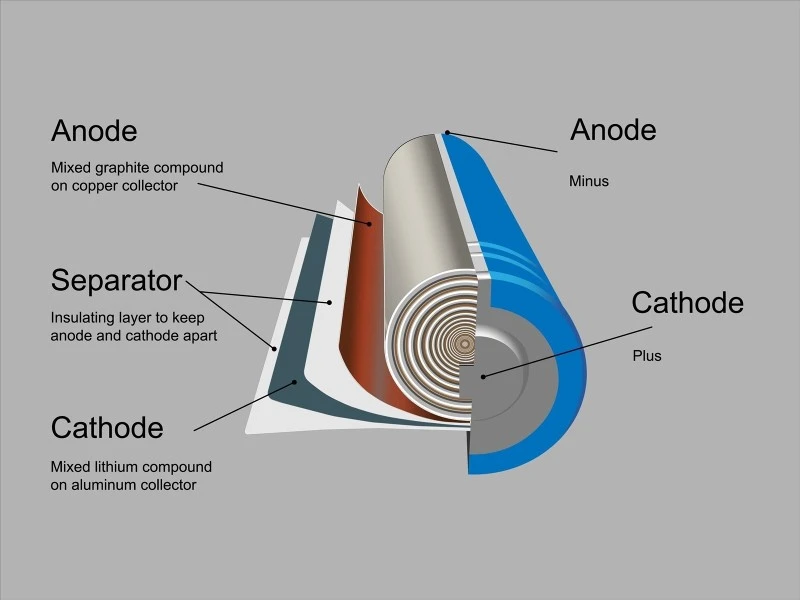
A liquid-electrolyte lithium-ion cell consists of four main components: a cathode, an anode, a separator, and an electrolyte. During normal operation, lithium ions migrate between the electrodes through the electrolyte, while the separator prevents direct electrical contact between the cathode and anode without obstructing ion transport.
When the separator is compromised or an unintended conductive pathway develops inside the cell, localized contact between the electrodes can occur, resulting in an internal short circuit (ISC). The resulting current can generate intense localized heat, potentially triggering exothermic side reactions involving the electrode materials and electrolyte. If these reactions accelerate, they may ultimately lead to thermal runaway.
|
Abuse Type |
Typical Scenarios |
Failure Mechanism |
Observable Warning Signs |
|
Mechanical Abuse |
Collision, compression, dropping, puncture, and mechanical stress during module assembly |
Cell deformation or separator damage → internal short circuit → localized overheating |
Casing deformation, abnormal voltage drop in an individual cell, localized heating, or abnormal temperature rise during storage |
|
Electrical Abuse |
Overcharging, incorrect wiring, incompatible or faulty chargers, and prolonged storage at high SOC under elevated temperatures |
Excessive charging voltage or current → lithium plating and accelerated side reactions → potential internal short circuit |
Extended charging time, abnormal temperature rise after charging, voltage irregularities, or unexpected capacity loss |
|
Thermal Abuse |
Prolonged exposure to direct sunlight, high temperatures inside vehicles, cooling system failure, and heat propagation between adjacent cells |
Continuous temperature rise → accelerated side reactions involving the SEI layer, electrolyte, and electrode materials → separator degradation or potential internal short circuit |
Abnormally high surface temperature, cell swelling, electrolyte leakage, or unusual acidic or solvent-like odors |
2.1 Mechanical Abuse: One of the Most Direct Causes
Collision, compression, dropping, and excessive mechanical stress during battery module assembly can cause cell deformation, separator damage, or internal component displacement. These changes may create unintended contact between electrodes, resulting in localized overheating and potential internal short circuits.
Some mechanical damage may not produce obvious external signs initially. Therefore, proper assessment should combine visual inspection, electrical performance testing, and necessary safety evaluations.
A typical failure sequence is:
Separator damage → contact between positive and negative electrodes → localized current concentration → abnormal heat generation.
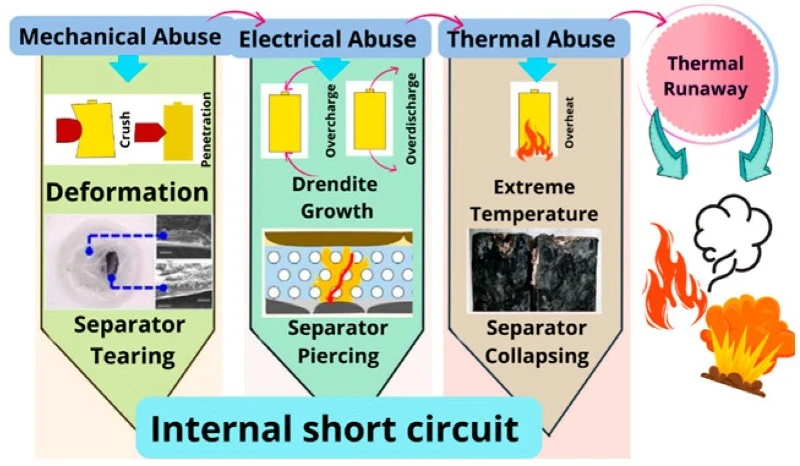
2.2 Electrical Abuse: A Gradual and Often Hidden Risk
Overcharging, improper wiring, faulty chargers, and prolonged storage at high SOC under elevated temperatures are common forms of electrical abuse. Unlike mechanical damage, electrical abuse may develop gradually, making early detection more difficult.
Overcharging: When cell voltage exceeds its specified upper limit, excessive side reactions may occur. Under certain conditions, metallic lithium can deposit on the anode surface, increasing the risk of internal short circuits.
Fast Charging and Low-Temperature Charging: Excessive charging rates or low temperatures can hinder lithium-ion intercalation into the anode, increasing the likelihood of lithium plating.
Faulty Chargers and Improper Wiring: Inadequate voltage and current regulation may expose cells to operating conditions beyond their specified limits, causing abnormal heat generation and accelerated degradation.
Unusually long charging times, persistent heating after charging, and accelerated capacity loss may indicate abnormal battery conditions.
2.3 Thermal Abuse: How Excessive Heat Triggers Battery Degradation
Thermal abuse occurs when prolonged exposure to external heat accelerates chemical degradation inside a battery cell. Common scenarios include electric vehicles charging under direct sunlight, battery packs installed near high-temperature components, and energy storage cabinets with insufficient ventilation or cooling.
Continuous temperature exposure can accelerate SEI layer and electrolyte decomposition, intensify electrode-electrolyte side reactions, and degrade the separator, potentially leading to thermal runaway.
Unusually high cell surface temperatures, casing swelling, electrolyte leakage, and abnormal solvent-like or acidic odors may indicate thermal abnormalities.
Internal short circuits are a common trigger of lithium-ion battery thermal runaway, although external heating, overcharging, and other abnormal operating conditions can also initiate the process.
Thermal runaway does not progress identically in all battery cells. Its onset temperature and rate of development depend on cathode chemistry, cell design, state of charge (SOC), aging, and heat dissipation capacity.
During this process, an internal short circuit or another abnormal condition generates localized heat, accelerating decomposition and exothermic reactions involving electrode materials and the electrolyte. These reactions release additional heat and gas, increasing internal pressure and potentially intensifying the process. Certain cathode chemistries may also release oxygen at elevated temperatures, further promoting internal reactions.
|
Development Stage |
Potential Internal Changes |
Observable External Signs |
|
Initial Heat Generation |
SEI layer decomposition begins, while side reactions between the electrolyte and electrode materials gradually increase. |
Abnormal temperature rise and possible cell swelling. |
|
Accelerated Reaction Stage |
Separator degradation increases the likelihood of internal short circuits, further intensifying exothermic reactions. |
Abnormal voltage fluctuations, rapidly rising temperature, and gas or smoke release. |
|
Thermal Runaway Stage |
Intense reactions between electrode materials and the electrolyte generate substantial heat and gas. |
Safety vent activation, gas venting, heavy smoke, and, in severe cases, flame ejection. |
Thermal runaway does not progress identically in all battery cells. Its onset temperature and rate of development depend on factors such as cathode chemistry, cell design, state of charge (SOC), aging, and heat dissipation capacity.
When a lithium-ion battery catches fire, carbon dioxide or dry chemical extinguishers may suppress visible flames temporarily, but they cannot necessarily stop the underlying thermal runaway. The cell may continue generating heat and releasing flammable gases through ongoing internal reactions, creating a risk of renewed smoke emissions and reignition.
Water-based extinguishing media provide cooling by absorbing thermal energy. Sustained cooling is essential to limit heat transfer between adjacent cells and reduce the risk of thermal propagation. However, when thermal runaway develops deep within a battery pack, externally applied water may not adequately cool all affected cells. Extended cooling, continuous temperature monitoring, and appropriate firefighting measures may therefore be necessary.
The disappearance of visible flames does not guarantee that the battery has reached a stable condition. Residual thermal energy can drive further decomposition and exothermic reactions after external combustion has ceased. As long as the internal temperature remains sufficiently high, reignition and further propagation remain possible.
|
Firefighting Method |
Primary Function |
Main Limitation |
Key Considerations |
|
Dry Chemical Extinguishers |
Suppress visible flames and reduce combustion intensity. |
Provide little cooling and cannot effectively remove residual heat within the cells. |
Flame suppression does not mean the fire is fully controlled. |
|
Fire Blankets |
Isolate flames and reduce radiant heat exposure. |
Cannot stop ongoing exothermic reactions within the cells. |
Not suitable as the primary measure for controlling battery thermal runaway. |
|
Water-Based Extinguishing Media |
Absorb heat and cool the battery and surrounding structures. |
May not rapidly reach the deeper parts of a battery pack, where residual heat can persist. |
Use should be managed by trained personnel in accordance with site-specific electrical and fire safety requirements. |
|
Gaseous Fire Suppression Systems |
Suppress flames within an enclosed space. |
Offer limited cooling and cannot ensure that internal thermal runaway reactions have stopped. |
Should be integrated with battery system design, smoke extraction, and post-suppression cooling measures. |
Newer fire suppression and heat mitigation technologies aim to improve extinguishing-agent coverage and heat removal within battery enclosures. However, their effectiveness depends on cell chemistry, enclosure design, agent penetration, and test conditions. Surface coverage alone does not demonstrate that internal thermal runaway reactions have been stopped.
If a battery emits smoke or catches fire, move away immediately, evacuate to a safe area, and contact the fire department. Never approach, handle, or attempt to dismantle the affected unit.
Beyond external abuse and manufacturing defects, liquid-electrolyte lithium-ion batteries have several material-related safety challenges. These involve electrolyte flammability, cathode thermal stability, anode reactions, and heat propagation within battery packs. Understanding these factors is important for material selection, cell design, and manufacturing quality control.
5.1 Flammability of Liquid Electrolytes
Many conventional lithium-ion cells use electrolytes formulated with organic carbonate solvents, lithium salts, and functional additives. This medium enables lithium-ion transport between the cathode and anode, but its organic solvent components are generally combustible.
When exposed to abnormal conditions such as excessive heat, overcharging, or an internal short circuit, the electrolyte may undergo decomposition and vaporization. These changes, together with other reaction products, can increase the likelihood of combustion. Improving electrolyte formulations, introducing flame-retardant additives, and refining cell structural design are therefore important strategies for reducing fire hazards.
5.2 Differences in the Thermal Stability of Cathode Materials
Certain layered oxide cathodes, such as high-nickel ternary materials and lithium cobalt oxide (LCO), may undergo structural degradation and decomposition at elevated temperatures. These changes can release oxygen and intensify exothermic reactions within the cell.
The thermal behavior of cathode chemistries varies considerably in terms of structural stability, oxygen release, and heat generation. Lithium iron phosphate (LFP), with its olivine crystal structure, generally exhibits greater resistance to heat-induced degradation. Nevertheless, this advantage does not make LFP batteries immune to thermal runaway. The overall outcome also depends on factors such as electrolyte flammability, anode chemistry, and cell design.
5.3 Lithium Plating and Internal Defects Are Not Easily Identified by Visual Inspection
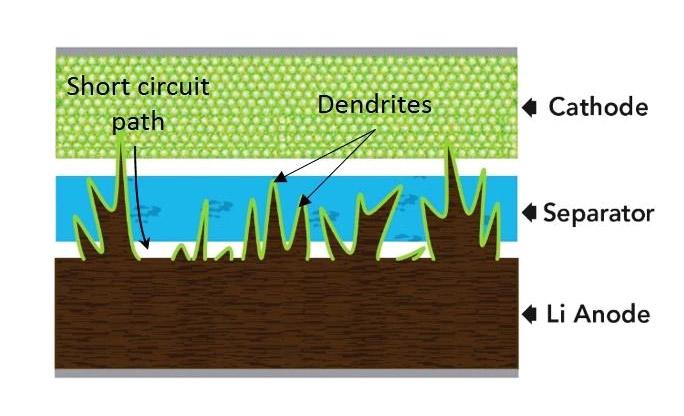
Overcharging, low-temperature or high-rate charging, and cell aging can promote abnormal metallic lithium deposition on the anode, commonly known as lithium plating. Under certain conditions, these deposits may develop into dendrites, potentially damaging the separator and increasing the risk of internal short circuits.
These internal changes may remain invisible during their early stages, making visual inspection alone inadequate for assessing cell condition. Electrochemical measurements, including capacity, internal resistance, and self-discharge testing, together with appropriate non-destructive inspection techniques, can provide additional information about potential abnormalities.
5.4 Thermal Runaway in One Cell Can Spread to Others
When an individual cell undergoes thermal runaway, the released heat, hot gases, and ejected materials may affect adjacent cells. Without adequate thermal insulation, cooling capacity, and gas venting, the resulting heat transfer may trigger further runaway events in neighboring units.
This cell-to-cell transmission is known as thermal propagation. Its prevention depends not only on individual cell performance but also on pack-level measures, including cell spacing, thermal barriers, cooling systems, venting pathways, and enclosure structure.
Battery safety depends on material properties, product design, manufacturing quality, verification procedures, and operating environments. Risk reduction therefore requires coordinated measures, including material improvements, optimized cell and pack structures, production quality control, and appropriate safety testing throughout the battery lifecycle. No individual test or protective measure can eliminate the possibility of thermal runaway in every scenario.
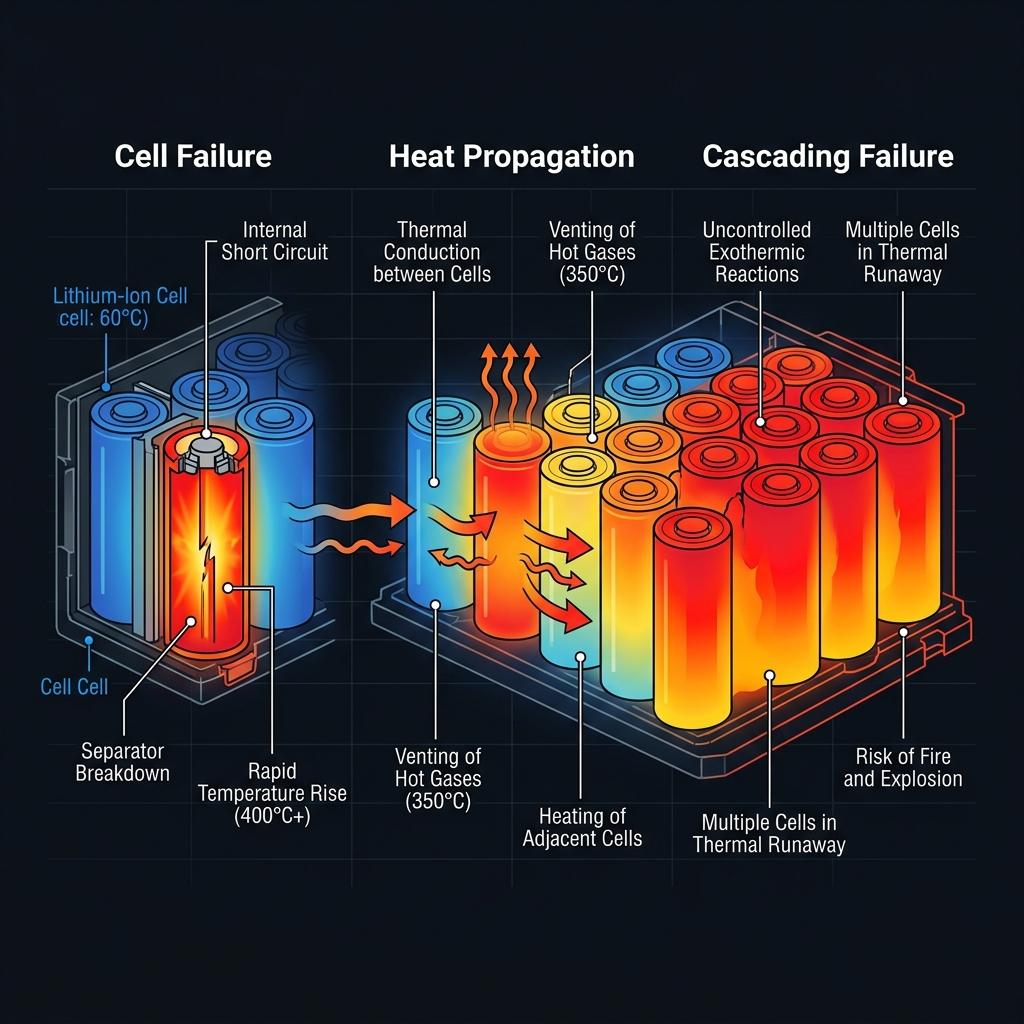
Some internal abnormalities in lithium-ion batteries can be reflected in changes in capacity, internal resistance, self-discharge, voltage, and temperature. Measuring and recording these parameters helps identify performance deviations and cell consistency issues during incoming inspection, production grading, pack assembly, and in-service maintenance.
For cell manufacturers, battery pack manufacturers, battery swapping operators, and energy storage system operators, standardized testing and traceable records support quality control and help identify abnormal cells before they progress into subsequent manufacturing or application stages.
6.1 Three Key Cell Performance Parameters to Monitor
• Internal Resistance Deviations: Aging, connection defects, and changes at electrode interfaces can all affect a cell's internal resistance. Increasing variations among cells within the same production batch may indicate uneven degradation or abnormal performance. Higher resistance also leads to greater Joule heat generation under the same current load. However, this parameter alone cannot predict which cell is most likely to undergo thermal runaway.
• Excessive Self-Discharge: This test measures voltage changes over a defined resting period under controlled conditions, from which the voltage decay rate or K-value can be calculated. Unusually high self-discharge may indicate internal side reactions, micro-short circuits, or other defects. Comparing measurements across the same batch helps identify outliers, although the K-value alone cannot pinpoint the nature or location of the underlying fault.
• Capacity and Cell-to-Cell Consistency:In a series-connected battery pack, cells need reasonably consistent capacity, voltage, and internal resistance. Large variations may cause individual units to reach their upper or lower voltage limits ahead of others during charging or discharging, increasing the likelihood of overcharge, over-discharge, and localized heating. Screening cells by these parameters before pack assembly helps improve overall consistency and operating stability.
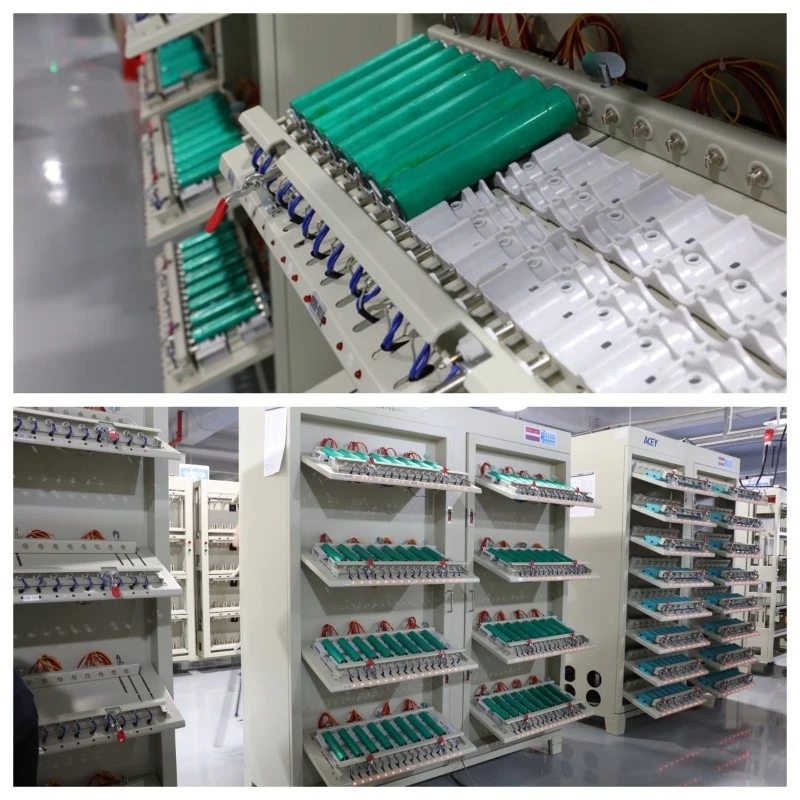
6.2 Seven Key Tests Covering Both Cell-Level and Pack-Level Assessment
|
Testing Level |
Test Item |
Test Scope |
Potential Abnormalities or Risk Indicators |
|
Cell-Level |
Capacity and Rate Capability Testing |
Discharge capacity and charge-discharge performance at different C-rates |
Capacity degradation and reduced rate capability |
|
Cell-Level |
DCIR / ACIR / EIS Testing |
DC resistance, AC resistance, and frequency-dependent impedance characteristics |
Abnormal resistance, cell-to-cell variations, and aging trends |
|
Cell-Level |
Self-Discharge Testing |
Voltage decay and K-value under specified storage conditions |
Excessive self-discharge and potential internal micro-short circuits |
|
Cell-Level |
Cell Consistency Grading |
Capacity, voltage, internal resistance, self-discharge, and other relevant parameters |
Significant parameter deviations within the same batch |
|
Cell-Level |
Internal Structure and Lithium Plating Assessment |
CT, X-ray, ultrasonic inspection, or thickness-change measurement, depending on the method used |
Internal structural anomalies and potential indications of lithium plating |
|
Cell-Level |
Abuse and Safety Testing |
Overcharge, crush, nail penetration, thermal exposure, and other tests under specified protocols |
Cell response and safety performance under defined abuse conditions |
|
Pack-Level |
Sealing, Insulation, and BMS Functional Testing |
Sealing integrity, insulation resistance, dielectric withstand, voltage and temperature sampling accuracy, protection logic, and communication functions |
Sealing defects, insulation failures, and BMS protection or communication faults |
The first six tests focus on cell-level performance, internal structure, and safety, while the final category evaluates battery pack integrity through sealing, insulation, and BMS functional testing.
6.3 Four Application Scenarios, Different Testing Requirements
Incoming Cell Inspection and Production-Line Sorting: Evaluate capacity, voltage, internal resistance, and self-discharge to identify abnormal cells and improve consistency before pack assembly.
Pack End-of-Line (EOL) Testing: Perform insulation resistance, dielectric withstand, airtightness, BMS communication, and protection function tests according to product specifications.
In-Service Vehicles and Battery Swapping Systems: Monitor capacity retention, cell voltage differences, internal resistance trends, and BMS alarm records to identify abnormal battery conditions.
Energy Storage Systems and Second-Life Batteries: Assess cell voltage, temperature, capacity retention, insulation, and consistency. Second-life batteries require additional performance and safety evaluation before reuse.
6.4 What Battery Testing Can and Cannot Do
• It Reduces Risk, but Cannot Eliminate It: Testing helps identify detectable defects and abnormalities, such as internal short circuits, lithium plating, and poor electrical connections, before pack assembly. This reduces the likelihood of defective cells proceeding to the next production stage.
• It Cannot Eliminate Inherent Safety Risks: Even cells that pass inspection may still undergo thermal runaway following physical damage, water ingress, or exposure to excessive external heat. A passing test result does not guarantee safety under all operating conditions.
• Testing Should Follow Applicable Standards and Regulations: Requirements for design validation, performance evaluation, safety testing, and transportation vary across battery applications. Test protocols should be selected according to product type, target market, and intended use, with reference to the latest applicable standards and their scope.
• Long-Term Trends Require Continuous Monitoring: A single test provides only a snapshot of cell condition. Tracking internal resistance, capacity, and cell-to-cell voltage differences over time helps identify abnormal variations and detect signs of performance degradation.
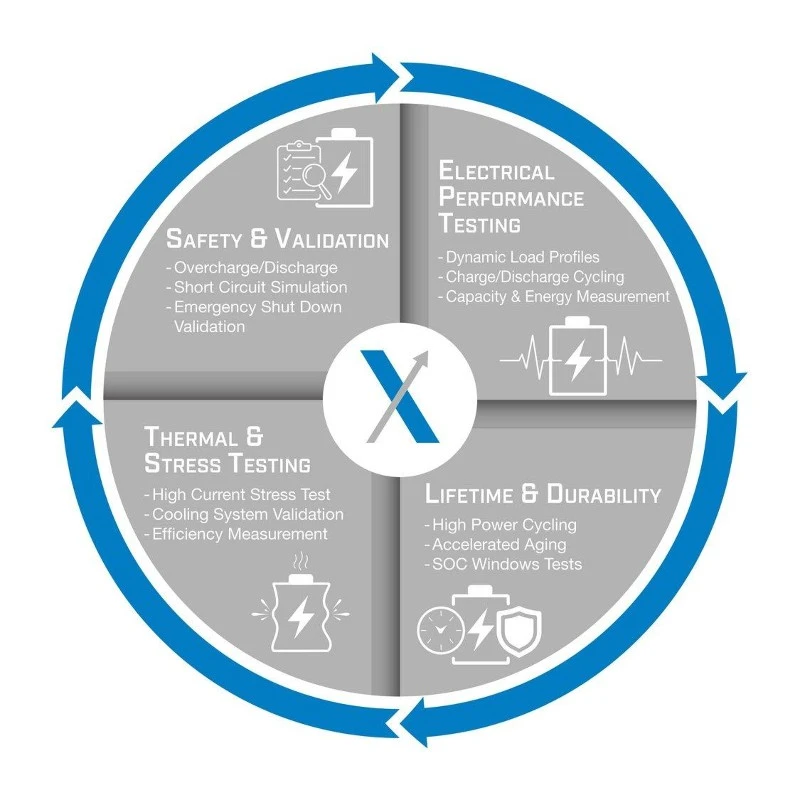
Lithium-ion battery safety depends on material properties, cell design, manufacturing quality, operating conditions, and protection systems. Once thermal runaway develops, residual heat and ongoing internal reactions may cause reignition and thermal propagation even after visible flames have been extinguished.
Reducing these risks requires a combination of appropriate cell design, manufacturing quality control, cell consistency grading, Pack end-of-line testing, and continuous monitoring. Although no single measure can eliminate all battery fire risks, comprehensive testing and safety management can help identify potential abnormalities and improve battery reliability.
Q: Why do lithium-ion batteries spontaneously catch fire?
Lithium-ion cells contain flammable electrolytes and materials capable of generating heat. If the separator fails and an internal short circuit occurs, exothermic reactions may accelerate into thermal runaway. Residual heat can also trigger reignition, even after visible flames have been extinguished.
Q: What are the warning signs of a lithium-ion battery fire?
Typical indicators include swelling, excessive temperature, unusually slow charging, incomplete charging, abnormal odors, casing discoloration, and sudden state-of-charge fluctuations. Discontinue use immediately, disconnect the charger if safe, and never attempt to open or repair the affected cell.
Q: Can a swollen lithium-ion battery still be used?
No. Swelling usually results from internal gas buildup caused by electrolyte decomposition or other side reactions. Continued operation or charging may worsen cell degradation and increase the likelihood of failure. Discontinue use and arrange disposal through an appropriate battery recycling or hazardous waste facility.
Q: Are lithium iron phosphate (LFP) batteries safer than ternary lithium-ion batteries?
Generally, yes. The stable olivine structure of LFP cathodes provides better thermal stability and typically lower heat release than ternary cathode materials under comparable conditions. Nevertheless, flammable electrolytes remain a concern, and internal short circuits, mechanical damage, or overcharging can still cause fires. Improved stability does not eliminate this possibility.
Q: What tests are typically performed on lithium-ion batteries, and how often should they be conducted?
Cell-level evaluations cover capacity, charge-discharge performance, DC internal resistance, AC impedance, self-discharge, and consistency grading. At the Pack level, common procedures include leak detection, insulation and dielectric withstand tests, BMS functional verification, and charge-discharge assessment.
The inspection schedule depends on cell chemistry, applicable quality standards, operating conditions, and manufacturer recommendations.
Q: What is battery cell consistency grading, and how does it help prevent fires?
Consistency grading groups cells according to capacity, voltage, internal resistance, and self-discharge characteristics to achieve better matching within a pack. Significant variations can lead to uneven current distribution, excessive stress, and localized heating. Proper cell matching improves pack reliability and reduces the likelihood of premature failure and thermal runaway propagation.
Contact ACEY for Battery Solutions
Xiamen Acey New Energy Technology Co., Ltd. supplies equipment for lithium-ion battery research, testing, and manufacturing, including battery cell testing systems, battery pack testing equipment, and battery pack assembly machinery.
If your project involves battery cell performance evaluation, cell consistency grading, battery pack testing, or manufacturing quality control, feel free to contact ACEY to discuss your equipment requirements and suitable solutions.
Website:https://www.aceymachinery.com/