During long-term use, lithium-ion batteries gradually lose their usable discharge capacity. This process, known as battery capacity degradation, is a natural part of battery aging.
The main causes include irreversible electrochemical side reactions, loss of lithium inventory (LLI), loss of active material (LAM), and electrolyte degradation. Temperature, charging and discharging conditions, and usage patterns also influence the rate of degradation.
However, temporary capacity reduction, such as that caused by low temperatures, does not necessarily indicate permanent degradation. Battery capacity testing, cycle testing, and internal resistance measurements help manufacturers monitor battery aging and evaluate capacity retention and cycle life.
Table of Contents
1. Electrochemical Degradation
2. Electrolyte Degradation and Consumption
3. Electrode Degradation and Internal Structural Changes
4. Effects of High and Low Temperatures
5. How to Assess Battery Capacity Degradation Using Battery Tests
6. How to Extend Lithium-Ion Battery Service Life
7. Conclusion
8. Frequently Asked Questions (FAQ)
Lithium-ion batteries store and release energy through the reversible movement of lithium ions between the cathode and anode. During repeated charge-discharge cycles, electrochemical side reactions occur at the electrode-electrolyte interfaces. Some of these reactions are irreversible, gradually reducing the battery's ability to store and deliver energy.
One example is the formation and growth of the solid electrolyte interphase (SEI) on the anode surface. A stable SEI layer helps limit further reactions between the anode and electrolyte. However, prolonged cycling can cause this layer to thicken or repeatedly crack and reform. These processes consume cyclable lithium and increase internal resistance, reducing the battery's usable capacity and overall performance.Similar side reactions can occur at the cathode-electrolyte interface. High operating voltages and elevated temperatures may accelerate these reactions, leading to the formation of additional interfacial compounds and further consumption of cyclable lithium and electrolyte.
Another contributing factor is the dissolution of transition metals from certain cathode materials. These dissolved metals can migrate to the anode surface, disrupting the stability of the SEI layer and promoting further side reactions.
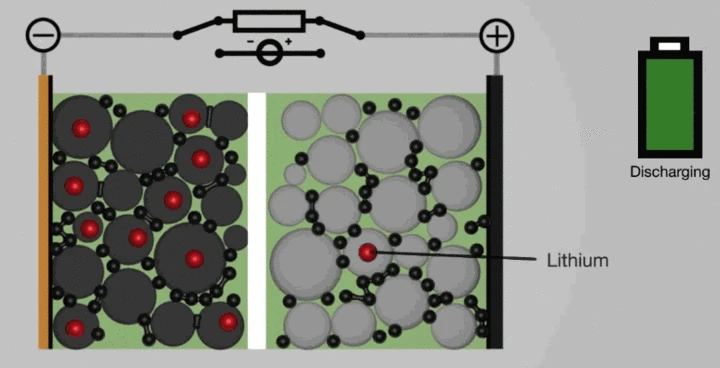
Over time, these processes reduce the amount of lithium available for reversible reactions and increase resistance to ion transport. This contributes to a gradual loss of usable capacity and a decline in battery performance over repeated use.
These degradation mechanisms are commonly associated with two key processes: loss of lithium inventory (LLI) and loss of active material (LAM). LLI occurs when some lithium becomes unavailable for reversible charge-discharge reactions, while LAM refers to the loss of electrode material that can actively participate in these reactions. Both processes contribute to a reduction in usable battery capacity.
The electrolyte plays a vital role in lithium-ion batteries by facilitating ion transport between the cathode and anode during charging and discharging.
Prolonged exposure to high temperatures, elevated voltages, and reactions at electrode surfaces can trigger oxidation, reduction, and decomposition of electrolyte components. These chemical changes gradually compromise the electrolyte's ability to support efficient ion transport.
The resulting effects include:
- Impaired ion transport: Changes in electrolyte composition can reduce ionic conductivity, making it more difficult for lithium ions to move between the electrodes.
- Altered electrode interfaces: Electrolyte decomposition products may accumulate on electrode surfaces, changing the interfacial environment and affecting electrochemical reactions.
- Electrolyte depletion: Ongoing side reactions consume electrolyte components, reducing the amount available for ion transport. In severe cases, this can lead to inadequate electrode wetting.
- Increased internal resistance: Changes in electrolyte properties and interfacial conditions can raise internal resistance, limiting charge and discharge performance.
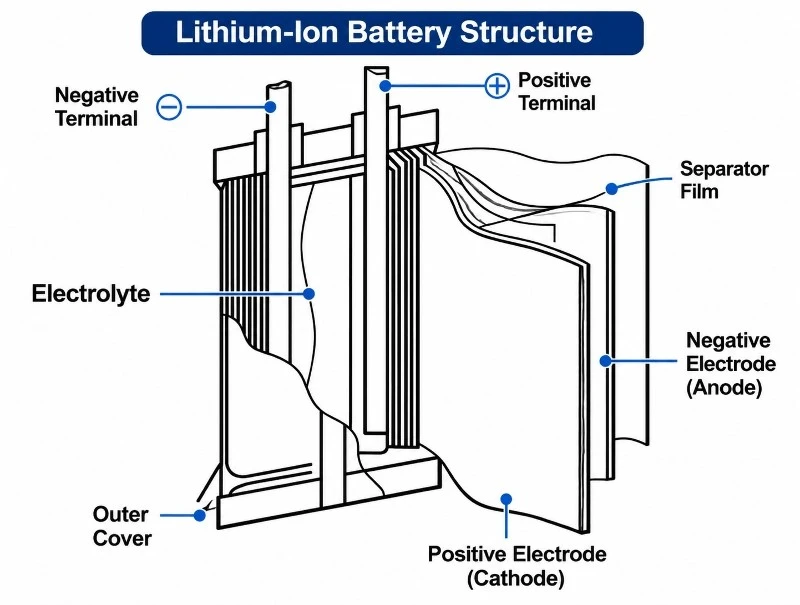
In properly sealed lithium-ion batteries, electrolyte decomposition and consumption are more accurate descriptions of these aging processes than evaporation or leakage. Leakage typically indicates a compromised seal or physical damage, rather than normal chemical aging.
As lithium ions move into and out of the electrode materials during charging and discharging, the electrodes undergo changes in volume. Repeated cycling can gradually lead to particle cracking, structural deterioration, and loss of active material.
When electrode particles crack, newly exposed surfaces may react with the electrolyte, accelerating interfacial side reactions. In addition, some active material may lose electrical contact with the conductive network, preventing it from fully participating in electrochemical reactions. These changes reduce the amount of active material available for reversible reactions and can further accelerate capacity degradation.
The resulting structural changes may lead to:
- Loss of electrochemically active material.
- Weakened electrical contact between electrode particles and the conductive network.
- Altered pathways for lithium-ion transport within the electrodes.
- Reduced electrode regions available for electrochemical reactions.
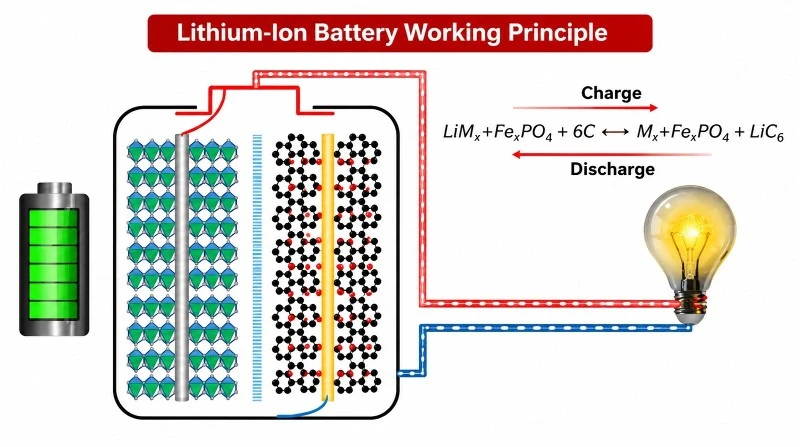
As material loss and structural deterioration accumulate, less electrode material remains available for reversible electrochemical reactions. This progressively reduces the battery's usable capacity and may shorten its cycle life.
Temperature plays a critical role in lithium-ion battery performance and aging.
High Temperatures
Prolonged exposure to elevated temperatures accelerates electrolyte decomposition, electrode interface reactions, and other degradation mechanisms. These processes consume cyclable lithium and damage electrode materials, causing capacity to decline more rapidly.
Low Temperatures
Cold conditions slow electrochemical reactions and lithium-ion diffusion, increasing internal resistance and reducing the energy available for discharge. Charging below the recommended temperature range can also promote lithium plating on the anode, potentially causing irreversible damage.
A temporary reduction in available capacity at low temperatures does not necessarily indicate permanent degradation. Some performance losses can be recovered once the battery returns to a suitable operating temperature. However, damage caused by lithium plating and other irreversible reactions may persist.
To maintain performance and extend service life, batteries should be charged, discharged, and stored within the temperature limits specified for their chemistry and by the manufacturer. Prolonged exposure to extreme temperatures should be avoided.
Battery capacity degradation cannot be accurately assessed through visual inspection or a single voltage measurement. A more reliable evaluation combines discharge capacity testing, charge-discharge cycle testing, and internal resistance measurements to monitor changes in battery performance.
5.1 Capacity Retention Testing
Capacity retention indicates the proportion of a battery's initial discharge capacity that remains after a specified number of charge-discharge cycles. It is calculated by comparing the measured discharge capacity after cycling with the initial value.
The formula is:
Capacity Retention (%)
= (Discharge Capacity After Cycling ÷ Initial Discharge Capacity) × 100%
For example, if a battery initially delivers 100 Ah and its measured discharge capacity is 90 Ah after a specified number of cycles, its capacity retention rate is 90%.
To ensure reliable comparisons, both measurements should be performed under consistent test conditions, including temperature, charge and discharge rates, cutoff voltages, and test procedures. Variations in these conditions can affect the measured capacity and lead to misleading retention results.
5.2 Charge and Discharge Cycle Testing
Charge and discharge cycle testing evaluates how battery performance changes during repeated cycling. By controlling charge current, discharge current, cutoff voltages, and cycle count, this method simulates the operating conditions a battery experiences over time.
Unlike a single capacity test, which measures a battery's discharge capacity under specified conditions, cycle testing tracks how this value changes over repeated cycles. During testing, the equipment follows a preset sequence of charging, discharging, and resting while recording voltage, current, and capacity data at each stage. Comparing discharge capacity across different cycles allows manufacturers to calculate capacity retention, monitor degradation trends, and evaluate cycle life.
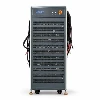
Long-term cycling tests require equipment capable of maintaining stable operating conditions, supporting continuous operation, and recording test data throughout the process. The ACEY-BA10020-40 Energy Feedback Battery Charging and Discharging Testing Machine is designed for battery pack charge-discharge and aging tests. It supports charging and discharging voltages of 10–100 V, with a maximum current of 20 A in each direction. These specifications support battery pack performance evaluation and cycle aging tests.


The machine uses energy feedback technology to recover energy released during discharge and feed it back into the power system, rather than dissipating it as heat through resistive loads. This helps reduce energy loss and heat generation during testing. Supported test steps include constant current (CC) charging, constant current-constant voltage (CCCV) charging, constant current discharging, resting, and cycling. Operators can configure up to 9,999 cycles and set charge-discharge parameters and test sequences according to battery specifications and evaluation requirements.
For data acquisition, the machine provides independent channel control, allowing each channel to operate according to its own settings. Voltage and current accuracy are ±(0.05% RD + 0.05% FS), with a minimum data logging interval of 5 seconds. The system records cycle count, charge and discharge capacity, charge and discharge energy, efficiency, and average voltage. Test data and curves can be exported to Excel for further analysis.
These records allow manufacturers to compare battery performance across different cycles, calculate capacity retention, and monitor changes in discharge capacity over time. The data can also support battery aging analysis and production quality control.
5.3 Internal Resistance Testing
Internal resistance is an important indicator of battery aging.
As a battery ages, interfacial changes at the electrodes, electrolyte degradation, and active material loss can contribute to increased internal resistance. This increase causes greater voltage drops and heat generation during charging and discharging, potentially reducing the battery's power capability.
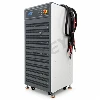
The ACEY Battery Comprehensive Tester measures battery pack voltage and AC internal resistance and supports charge-discharge testing. These functions help manufacturers identify abnormal electrical characteristics and assess battery condition during production inspections.
However, internal resistance alone cannot directly quantify capacity loss. The relationship between resistance increase and capacity reduction is not fixed. A battery may show a significant rise in internal resistance while retaining much of its original capacity.
Therefore, internal resistance testing is best used to monitor changes in battery condition rather than as a standalone measure of capacity degradation. Standardized discharge capacity tests are needed to determine actual capacity retention, while cycle testing tracks how battery capacity and performance change over repeated charge-discharge cycles.
5.4 Relationship Between Capacity Degradation and Cycle Life
Battery cycle life describes the number of charge-discharge cycles a battery can undergo before its capacity retention falls below a specified threshold under defined test conditions.
As the battery undergoes repeated charge-discharge cycles, its capacity gradually declines due to ongoing electrochemical and structural changes. Once capacity retention reaches the specified end-of-life threshold, the battery is considered to have reached the end of its cycle life under those test conditions.
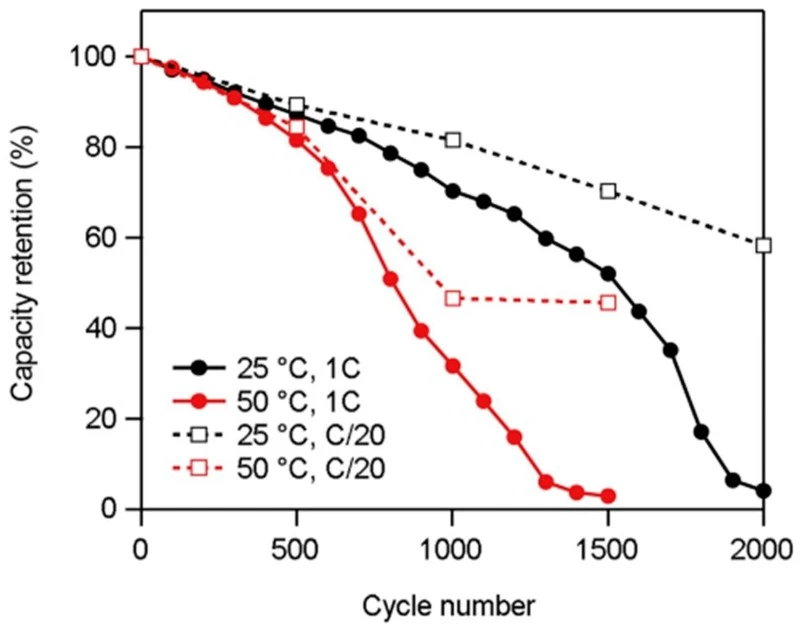
Cycle life varies depending on several factors, including battery chemistry, charge and discharge rates, operating temperature, voltage limits, and testing protocols. Therefore, comparisons between batteries should be based on equivalent test conditions and the same capacity retention threshold.
Although capacity degradation is inevitable, proper operating practices and battery management can help slow the aging process.
- Control Operating Temperature: Avoid prolonged exposure to extreme temperatures, as excessive heat and cold can accelerate battery aging and shorten service life.
- Manage Charging and Discharging: Set charging and discharging voltages, currents, and cutoff limits according to battery specifications and manufacturer recommendations. Avoid overcharging and excessive discharge to reduce unnecessary stress on the battery.
- Maintain Appropriate Storage Conditions: For long-term storage, follow the manufacturer's recommendations for temperature and state of charge (SOC) to limit capacity loss during periods of inactivity.
- Strengthen Manufacturing Quality Control:During production, cell sorting, capacity testing, internal resistance measurement, and battery pack charge-discharge testing help identify cells and packs with abnormal electrical characteristics or performance variations. Proper control of pack assembly processes and electrical connections further helps reduce manufacturing inconsistencies.
For battery manufacturers, consistent cell matching, reliable pack assembly, and comprehensive end-of-line testing are essential to ensuring uniform battery performance and product reliability.
Lithium-ion battery capacity degradation is a gradual process driven by electrochemical side reactions, loss of cyclable lithium, active material degradation, electrolyte decomposition, and operating conditions. Together, these factors reduce the battery's usable capacity over time and repeated charge-discharge cycles.
Although capacity degradation is unavoidable, it can be slowed through improvements in battery materials and manufacturing processes, along with proper charging, discharging, and storage management.
For battery manufacturers, capacity testing, charge-discharge cycle testing, and internal resistance measurement provide essential data for assessing battery performance and monitoring degradation. Combined with consistent cell selection, controlled pack assembly, and comprehensive end-of-line testing, these measures help improve battery consistency, reliability, and overall product quality.
Q1: Why Does Lithium-Ion Battery Capacity Decrease Over Time?
Lithium-ion batteries gradually lose capacity due to irreversible electrochemical side reactions, loss of lithium inventory, loss of active material, and electrolyte degradation. These processes reduce the amount of lithium and active electrode materials available for reversible reactions, resulting in lower usable capacity.
Q2: What Does Battery Capacity Retention Indicate?
Battery capacity retention indicates how much of a battery's original discharge capacity remains after use or repeated cycling. A lower retention value generally reflects greater capacity degradation. It is commonly used to evaluate battery aging, compare performance under defined test conditions, and assess cycle life.
Q3: Does Increased Internal Resistance Indicate Capacity Loss?
Not necessarily. Higher internal resistance may result from electrode interface deterioration, electrolyte degradation, or changes in internal transport properties. Although it can reduce power output and affect charge-discharge performance, resistance growth does not directly correspond to capacity loss. A standardized discharge capacity test is necessary to determine the actual capacity reduction.
Q4: Can Low Temperatures Cause Permanent Battery Capacity Loss?
Not necessarily. Low temperatures can temporarily reduce the usable discharge capacity of lithium-ion batteries by slowing electrochemical reactions and lithium-ion diffusion. Some of this performance reduction can recover when the battery returns to a suitable operating temperature. However, charging at temperatures below the recommended range may cause lithium plating, which can lead to permanent capacity loss.
Contact ACEY for Battery Solutions
Xiamen Acey New Energy Technology Co., Ltd. supplies equipment for lithium-ion battery research, testing, and manufacturing, including battery cell testing systems, battery pack testing equipment, and battery pack assembly machinery.
If your project involves battery cell performance evaluation, cell consistency grading, battery pack testing, or manufacturing quality control, feel free to contact ACEY to discuss your equipment requirements and suitable solutions.
Website:https://www.aceymachinery.com/