Explanation of Lithium Battery Terminology
1. Battery Voltage
● Open circuit voltage
Open circuit voltage refers to the voltage value between the two terminals of the battery measured directly by the instrument when the battery is not in working state. The open circuit voltage has a certain relationship with the remaining power of the battery, and the power display uses this principle. The open circuit voltage cannot be used as a standard to measure the battery voltage.
The battery's charging state can be judged by the open circuit voltage of the battery. Taking 12v batteries as an example, 12v batteries are mainly used in ships, mobile lighting, RVs and other fields.
● Working voltage
The working voltage refers to the potential difference between the positive and negative electrodes of the battery when the battery is in working state, that is, when current flows through the circuit.
In the working state of battery discharge, when the current flows through the battery, it must overcome the resistance of the internal resistance, so the working voltage is always lower than the open circuit voltage.
● Discharge cut-off voltage
The discharge cut-off voltage refers to the voltage reached when the battery is fully charged and discharged.
2. Battery Capacity
The battery capacity refers to how much power the battery can store. The capacity is an important indicator of the battery's electrical performance and is determined by the active material of the electrode.
Capacity is represented by C, and the unit is Ah (ampere-hour) or mAh (milliampere-hour). For a battery with a capacity of 10 amperes, 5 amperes can discharge for 2 hours, and 10 amperes can discharge for 1 hour. Battery capacity can be divided into theoretical capacity, rated capacity, and actual capacity.
In the lithium battery industry, we need to use a capacity testing machine to test and grade the batteries in the battery pack to understand the actual capacity and performance of the battery. By performing multiple charge and discharge cycles on the battery, the capacity, voltage and other parameters of each battery can be accurately evaluated, thereby ensuring that each battery in the battery pack is as consistent as possible in performance.

3. Battery Internal Resistance
Battery internal resistance refers to the resistance to current flowing through the battery when the battery is working. The size of the internal resistance is mainly affected by factors such as battery material, manufacturing process, and battery structure. Battery internal resistance includes ohmic internal resistance and polarization internal resistance.
●Ohmic internal resistance
Ohmic internal resistance is composed of electrode material, electrolyte, diaphragm resistance, and contact resistance of each part. Ohmic resistance obeys Ohm's law. Polarization resistance increases with the increase of current density, but it is not linear, and often increases linearly with the logarithm of current density.
●Internal polarization resistance
Internal polarization resistance includes resistance caused by electrochemical polarization and concentration polarization.
Due to the existence of internal resistance, when the battery is discharged, the current passes through the internal resistance to generate heat and consume energy.
The internal resistance of the battery is not constant, and it will change over time during discharge. Because the composition of the active material, the concentration of the electrolyte, the temperature, etc. are constantly changing.
4. Battery Charging and Discharging
●Charging Rate
C is the first letter of the capacity, which is used to indicate the magnitude of the current when the battery is charged and discharged. For example, when the rated capacity of the rechargeable battery is 1100mAh, it means that the discharge time at 1100mAh (1C) can last for 1 hour. If the discharge time at 200mAh (0.2C) can last for 5 hours, the charge amount can also be calculated based on this comparison.
●Discharge Rate
The discharge rate refers to the current value required to discharge its rated capacity within a specified time, which is numerically equal to a multiple of the rated capacity of the battery.
When discharging with 48A, its discharge rate is 2C. On the contrary, when discharging with 2C, the discharge current is 48A and the discharge time is 0.5 hours. When charging with 12A, its charge rate is 0.5C. On the contrary, when charging with 0.5C, the charge current is 12A and the charging time is 2 hours.
The charge and discharge rate of the battery determines how fast we can store a certain amount of electrical energy into the battery, or how fast we can release electrical energy into the battery.
● Depth of Charge and Discharge
The expression of the battery's retained capacity value. The depth of charge and discharge is expressed in percentage.
SOC: State of charge, which indicates the ratio of the remaining capacity of the battery to the capacity of the fully charged state after a period of use or long-term storage, is usually expressed in percentage. Its value range is 0~1, SOC=0 means that the battery is fully discharged, and SOC=1 means that the battery is fully charged.
DOD: The depth of discharge of the battery is 0 when it is fully charged, and its DOD is 1 when it is fully discharged. Therefore, in general, the DOD of the battery has a value between 0 and 1, and the relationship between DOD and SOC is: DOD + SOC = 1.
5. Battery Energy
Refers to the amount of energy stored in the battery, in Wh. Battery energy is an important indicator of the work done by battery-driven equipment, and capacity cannot determine the amount of work done.
●Energy density
Refers to the energy released per unit volume or mass, usually expressed as volume energy density (Wh/L) or mass energy density (Wh/kg).
●Power density
Divide energy by time to get power, in W or kW. Specific power is an important indicator for assessing whether the battery meets the acceleration requirements of electric vehicles.
6. PACK
Lithium battery PACK is a battery combination system that combines single or multiple lithium battery cells in series and parallel, and is equipped with necessary protection circuits, housings and connection devices to meet specific application requirements. At the same time, Pack is also widely used in electric vehicles, energy storage systems, aerospace, power tools and other fields, providing reliable energy solutions for various industries.

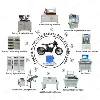
Pack test equipment is a key equipment specially used to evaluate and test the performance of PACK, including aging machine, BMS tester, comprehensive tester, etc. These equipment can comprehensively evaluate the electrochemical capability, environmental function, safety capability, protection board function, charge and discharge performance, etc. of the battery pack to ensure the safety and reliability of the battery pack in electric vehicles, energy storage systems and other applications.
Acey new energy is a professional supplier specialized in Lithium Battery Pack Assembly Machine and we provide one-stop solution for cylindrical battery pack assembly line. If any interested, please feel free to contact us.