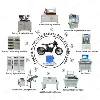
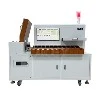
First of all, let's understand the action process steps of gantry manual spot welding machine.
Power on - detect whether the WELED switch is turned on - place the product that needs to be welded on the desktop - step pedal - sonotrode press down - spot welding completed - sonotrode return to position
Next, let's analyze the precautions in the welding process
1. First of all, the battery cells should be neatly arranged on the battery cell holder according to the battery pack process specifications, and it should be noted here that the positive and negative poles of the battery cells cannot be placed wrong, otherwise it will lead to a short circuit in the battery pack.
2. Place the nickel sheet, and place the nickel sheet position accurately according to the process design requirements of the battery pack.
3. Choose the right solder pin according to your needs
(1) 1.7 straight-through solder pin: the most commonly used solder pin model, the versatility is better, suitable for 0.12mm-0.18mm nickel sheet.
(2) 3.0 eccentric spot welding pin: usually the front end is turned to 1.7/2.0 use, because the welding pin is thick, so you can weld thicker nickel sheets, conventional welding nickel sheet thickness between 0.15-2.0mm. After the front end of the solder pin is consumed, the front end of the solder pin is polished by lathe processing. Because the diameter is relatively large, the conductivity effect is good, and the heat dissipation effect is good, which is conducive to welding. It is usually suitable for welding larger battery packs.
(3) 6.0 bump welding pin is usually used for bump nickel sheet welding, for products with high battery pack quality requirements, battery packs that often produce vibration or impact, or battery packs with large current overload, can use bump nickel sheet welding, welding is more convenient and not easy to stick needles. Such as drone battery packs, power car battery packs, etc.
4. Place the assembled battery pack on the welding platform, adjust the welding head or welding pin according to the height of the battery pack, and keep the distance between the welding pin and the battery cell 2-3mm.
5. Adjust the appropriate solder pin spacing and sonotrode pressure as needed.
6. After the power supply is turned on, adjust the parameter power supply current, and adjust the suitable welding current according to the thickness of the nickel sheet.
7. During the welding process, it is necessary to keep no other impurities remaining on the surface of the nickel sheet and the battery, otherwise there will be poor welding such as explosion.
8. The solder joints are evenly distributed and arranged neatly, do not solder deviation or solder joints between the gaps between the positive and negative poles.
9. Pay attention to the number of solder joints, welding battery packs are generally spot welded twice to form four solder joints. Avoid virtual welding of solder joints and reduce the probability of virtual welding. The solder joints have better conductivity and high firmness, but for general battery pack welding, four solder joints are enough. The number of solder joints depends on the needs of the battery pack process design.
10. When spot welding, pay attention to the work surface can not be placed conductive objects, can not wear watches, rings and other metal objects. Protective equipment such as goggles and insulating gloves should be worn.
11. Regularly grind the front end of the welding pin to prevent impurities caused by oxidation on the surface of the welding pin from causing poor welding.
12. When welding a larger battery pack, an epoxy plate should be placed, and one part of the welding is to cover the epoxy plate in this part, and then weld another part to prevent welding spatter and other phenomena.