A Complete Guide to Ultrasonic Aluminum Wire Bonding
In today's lithium battery manufacturing industry, reliable electrical connections are essential for ensuring battery safety, performance, and long service life. As battery energy density continues to increase, manufacturers require joining technologies that provide low electrical resistance, high mechanical strength, and excellent production efficiency.
One of the most widely adopted solutions is the ultrasonic wire bonding machine. Unlike traditional soldering or resistance welding, ultrasonic wire bonding uses high-frequency vibration and controlled pressure to create a solid-state metallurgical bond without melting the materials. This process is especially suitable for connecting aluminum wires to battery tabs, busbars, and power electronic modules.

This article explains how a wire bonder machine works, its major components, the complete bonding process, and why it has become an essential piece of equipment in modern lithium battery production.
What Is a Wire Bonder Machine?
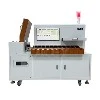
A wire bonder machine is an automated welding system that connects conductive aluminum wire between battery tabs, busbars, or electronic terminals using ultrasonic energy.
In lithium battery manufacturing, ultrasonic wire bonding is commonly used for:
- Cylindrical battery modules (18650, 21700, 26650, 32700, 33140)
- Prismatic battery modules
- Energy storage battery packs
- EV battery modules
- Automotive electronic components
Compared with conventional welding methods, ultrasonic wire bonding creates reliable electrical connections without generating excessive heat, making it ideal for sensitive battery materials.
Why Is Ultrasonic Wire Bonding Used in Lithium Battery Manufacturing?
Battery manufacturers choose ultrasonic aluminum wire bonding because it offers several important advantages:
- Lower electrical resistance
- Higher conductivity
- Minimal thermal impact on battery cells
- Excellent mechanical strength
- Fast production speed
- Stable automated production
- Long-term connection reliability
As battery packs become larger and operate at higher currents, aluminum wire bonding has become a preferred alternative to traditional nickel strip welding in many applications.

How Does a Wire Bonder Machine Work?
The entire bonding process is fully automated and controlled by industrial motion software. A typical production cycle includes the following steps.
Step 1. Load the Battery Module
The operator places the battery module into the fixture.
The positioning fixture ensures every battery remains in exactly the same location before bonding begins.
Step 2. Automatic Vision Positioning
The machine's industrial vision system automatically identifies every bonding position.
Instead of relying on manual alignment, image recognition locates battery tabs and busbars with high repeatability, significantly improving production consistency.
Step 3. Aluminum Wire Feeding
The wire feeding mechanism automatically supplies aluminum wire to the bonding head.
Depending on the application, the equipment supports aluminum wire diameters from 125 μm to 500 μm (5–20 mil), making it suitable for both standard battery modules and high-current power applications.
Step 4. Ultrasonic Bonding
This is the core of the process.
The bonding head presses the aluminum wire against the workpiece while simultaneously applying:
- Ultrasonic vibration
- Controlled bonding pressure
- Precise bonding time
These three parameters remove surface oxides and create a solid-state metallurgical bond without melting the materials.
Because no filler metal is required, the resulting joint has excellent electrical conductivity and long-term reliability.
Step 5. Rotary Bonding Head Movement
Modern ultrasonic wire bonders use a rotary bonding head.
The bonding head automatically moves to the next bonding point while maintaining accurate wire routing and consistent loop geometry.
This design improves both production speed and bonding quality.
Step 6. Quality Inspection
After each bond is completed, the system verifies the bonding process through its vision and motion control system.
Any abnormal bonding conditions can be identified immediately, reducing scrap and improving manufacturing yield.
How to Choose the Right Wire Bonder Machine?
When selecting a wire bonding machine, manufacturers should evaluate:
- Aluminum wire diameter range
- Production capacity
- Vision positioning accuracy
- Motion repeatability
- Ultrasonic control system
- Software flexibility
- Automation level
- Equipment compatibility with existing production lines
Choosing a machine that supports programmable parameters and automatic vision alignment helps improve both product consistency and production efficiency.
Conclusion
Ultrasonic wire bonding has become one of the most reliable connection technologies in lithium battery manufacturing. By combining ultrasonic vibration, precise pressure control, automatic vision positioning, and intelligent motion control, a modern wire bonder machine can produce high-strength, low-resistance electrical connections while maintaining excellent production efficiency.
For manufacturers seeking stable quality and scalable automation, an ultrasonic wire bonder is a valuable investment for battery module and pack production.
Looking for a high-precision wire bonder machine?
ACEY New Energy offers automatic ultrasonic wire bonding solutions designed for cylindrical, prismatic, and energy storage battery manufacturing. Contact our engineering team to discuss your production requirements and receive a customized solution.

FAQ
FAQ 1. What is the difference between ultrasonic wire bonding and laser welding?
Ultrasonic wire bonding uses high-frequency vibration and pressure to create a solid-state connection without melting the materials. Laser welding uses heat to melt and join metal parts. For lithium battery modules, ultrasonic wire bonding is often preferred because it produces low-resistance connections with minimal thermal damage.
FAQ 2. What materials can a wire bonder machine bond?
A wire bonder machine is mainly used for bonding aluminum wires with battery tabs, busbars, and conductive terminals. It is widely applied in lithium battery modules, EV battery packs, energy storage systems, and power electronic components such as IGBT modules.
FAQ 3. What factors affect wire bonding quality?
Wire bonding quality is affected by ultrasonic power, bonding force, bonding time, wire diameter, surface cleanliness, and positioning accuracy. Proper parameter adjustment and stable machine control help achieve stronger bonds and improve production consistency.